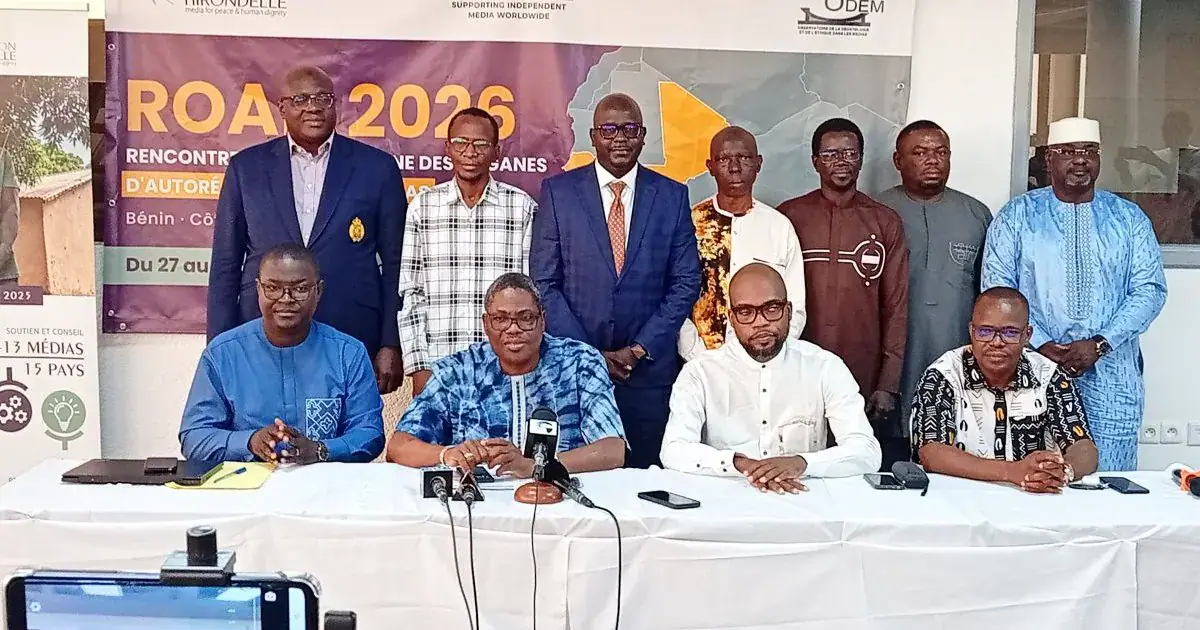
Representatives from Benin, Togo, Côte d'Ivoire, Senegal, and Mali gathered in Cotonou on October 29-30 to discuss the future of media self-regulation in West Africa. The meeting, initiated by Benin's Observatoire de la déontologie et de l'éthique dans les médias (ODEM), aims to harmonize practices and enhance the impact of media watchdogs in the region. ODEM's president, Tanguy Agoï, emphasized the need for greater consistency in procedures, attitudes, and assessments among media regulatory bodies.
The meeting marks the culmination of a long-standing project, with Agoï stressing that cooperation is essential in the face of challenges such as artificial intelligence, insecurity, and geopolitical shifts. He advocated for a unified approach to journalism, suggesting that professional standards should be similar across countries. The goal is to establish a common voice for media regulatory bodies in West Africa, enabling them to address issues more effectively.
The Fondation Hirondelle is supporting this initiative, with funding from the European Union. Olympe Dossa, the foundation's representative in Benin, highlighted the democratic significance of this cooperation, emphasizing that journalism plays a crucial role in informing citizens, fostering public debate, and promoting understanding among nations.
Hervé Prudence Hessou, president of the Union des professionnels des médias du Bénin (UPMB) and vice-president of the Assemblée spéciale, noted that deontology is not a constraint for journalists but rather a distinguishing feature that sets them apart from rumor-mongers. He stressed that the profession relies on trust, which is built slowly and can be lost instantly.
Dr. François Awoudo, secretary-general of the Haute Autorité de l'audiovisuel et de la communication (HAAC), presented an overview of the current state of media regulatory bodies in the region. He observed that these bodies are often weakened, dormant, or constrained, and urged them to regain their vitality in the face of political and security challenges.
Awoudo emphasized that the revitalization of media watchdogs requires more than just declarations of intent. He stressed that their credibility depends on factors such as the legitimacy of their leaders, respect for mandates, regular activities, and the publication of decisions. Professional associations and press organizations must also provide sustained support to these structures.
The meeting in Cotonou aims to lay the groundwork for a West African media regulatory body, with discussions focusing on issues such as adapting to online media, developing in-house ethics mechanisms, and securing financial resources for training, awareness-raising, and monitoring professional practices.
Key points
- West African media regulatory bodies are seeking to strengthen cooperation and harmonize practices.
- The meeting in Cotonou aims to establish a common voice for media watchdogs in the region.
- The initiative is supported by the Fondation Hirondelle and funded by the European Union.