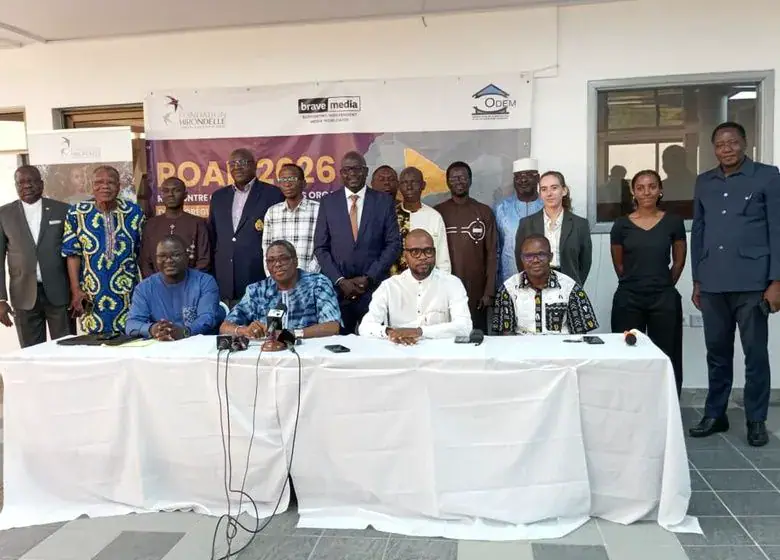
Media regulatory bodies from West African countries have converged in Cotonou, Benin, to discuss ways to enhance cooperation and tackle common challenges facing the media industry in the region. The meeting, which took place from October 29 to 30, 2026, was organized by the Observatory of Deontology and Ethics in Media (ODEM) of Benin, with the support of the Hirondelle Foundation. The gathering aimed to lay the groundwork for closer cooperation among professional media structures in the region.
The challenges facing West African media outlets are increasingly similar, including artificial intelligence, disinformation, insecurity, geopolitical tensions, and the fragilization of media enterprises. According to Thanguy Agoï, president of ODEM's 10th term, these challenges require concerted responses. He emphasized the need for harmonized professional behavior and common deontological principles for journalists across the region. Agoï cited artificial intelligence, insecurity, and geopolitical developments as some of the key challenges that require a unified approach.
The meeting aimed to facilitate the sharing of experiences and best practices among media regulatory bodies in the region. Participants also sought to develop common mechanisms to strengthen media self-regulation in West Africa. This, according to Agoï, will enable national regulatory bodies to better address professional misconduct and pressure faced by journalists. The goal is to establish a common voice for media regulatory bodies at the West African level.
Hervé Prudence Hessou, vice-president of the Special Assembly of Press Organizations in Benin, highlighted the importance of building trust with the public. He noted that trust is easily lost if journalists fail to uphold ethical standards, citing sensational headlines, unverified information, and rapid dissemination of rumors. Hessou emphasized that deontology should not be seen as a constraint but as a distinguishing feature of journalistic work.
The Hirondelle Foundation, a partner in the meeting, underscored the value of sub-regional cooperation. Olympe Dossa, the foundation's representative in Benin, praised the initiative, which allows media actors to share experiences and learn from each other's successes and challenges. He believed that this collaboration can contribute to consolidating gains and promoting reliable, independent, and credible information for the benefit of the population.
The meeting also recognized the complementarity between regulation and self-regulation. Dr. François Awoudo, secretary-general of the High Authority of Audiovisual and Communication (HAAC), representing the HAAC president, emphasized that regulation and self-regulation are interdependent. He noted that without regulation, self-regulation faces challenges, and without self-regulation, regulation is incomplete.
The discussions focused on key issues related to self-regulation in the sub-region, including security, democracy, and freedom. The meeting provided a platform for media regulatory bodies to explore ways to address common challenges and promote a culture of ethics and accountability in the media industry. The outcome of the meeting is expected to contribute to the development of a more cohesive and effective approach to media regulation in West Africa.
Key points
- Media regulatory bodies from West Africa meet to enhance cooperation on ethics and regulation.
- The meeting aimed to develop common mechanisms to strengthen media self-regulation in the region.
- Participants emphasized the importance of building trust with the public and promoting reliable, independent, and credible information.