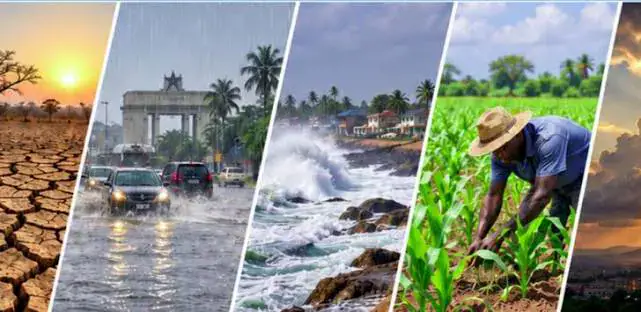
West African governments are being urged to strengthen preparations for the potential impacts of the 2026–2027 El Niño event. Climate and public-health specialists warn that changing rainfall patterns and rising temperatures could put food production, water supplies, and public health under pressure. Delayed rainfall and prolonged dry spells could disrupt farming activities, particularly among farmers who depend on rain-fed agriculture and have limited access to irrigation.
Climate scientist Dr. Caleb Mensah warned that the interval between early rainfall events could be long enough to affect crop establishment. He said the gap between the first and second rainfall events could extend to two or three weeks, creating difficulties for farmers who plant in response to the first rains. Dr. Mensah, a Senior Lecturer at the University of Energy and Natural Resources, noted that farmers could struggle to achieve their usual production levels if rainfall is delayed or inadequate while temperatures remain high.
The consequences of reduced rainfall could extend beyond individual farms, putting additional pressure on food availability and the movement of agricultural produce to markets. Dr. Mensah also raised concerns about farmers' access to drought-resistant seeds, despite agricultural research institutions having developed crop varieties capable of tolerating drought conditions for longer periods. He questioned how widely farmers could obtain these seeds, citing drought-tolerant seed varieties developed by the Council for Scientific and Industrial Research.
The potential consequences of reduced rainfall could also affect water resources and electricity generation. Dr. Mensah said lower-than-expected rainfall could affect hydrological systems, including water inflows into the Volta and Lower Volta systems. For Ghana, where hydroelectricity is an important part of the energy mix, reduced inflows could create additional pressure on electricity generation. However, he stressed that the scale of the impact would depend partly on the preparedness measures taken by governments and other stakeholders.
The World Health Organization (WHO) warns that countries are not fully prepared to deal with the potential health impacts of El Niño. Dr. Patrick Otim, Programme Area Manager for Emergency Response at the WHO's Regional Office for Africa, described El Niño as a risk modifier, explaining that its health consequences would depend on the hazards experienced, existing vulnerabilities, and the capacity of health systems to respond. Potential health concerns include heat-related illnesses, malnutrition linked to food insecurity, and waterborne, foodborne, and vector-borne diseases.
Dr. Otim identified inadequate food storage and limited national food reserves as major preparedness concerns. He called for a coordinated, whole-of-government response involving the health, agriculture, water, and disaster-management sectors. Such preparations should include contingency plans, risk maps, identification of high-risk communities, and the pre-positioning of essential supplies before emergencies occur. He also urged countries to strengthen health alerts, nutrition screening, and disease surveillance while ensuring that essential health services remain operational.
The WHO official also highlighted the need to protect communities with limited access to healthcare, particularly in countries within Africa's meningitis belt. Dr. Otim stressed the importance of effective surveillance to identify suspected cases, confirm the bacteria responsible, and guide an appropriate response, including vaccination where necessary. Journalists were urged to turn climate warnings into practical information to support preparedness efforts.
Key points
- West African governments are being urged to strengthen preparations for the potential impacts of the 2026–2027 El Niño event.
- The interval between early rainfall events could be long enough to affect crop establishment.
- The WHO warns that countries are not fully prepared to deal with the potential health impacts of El Niño.