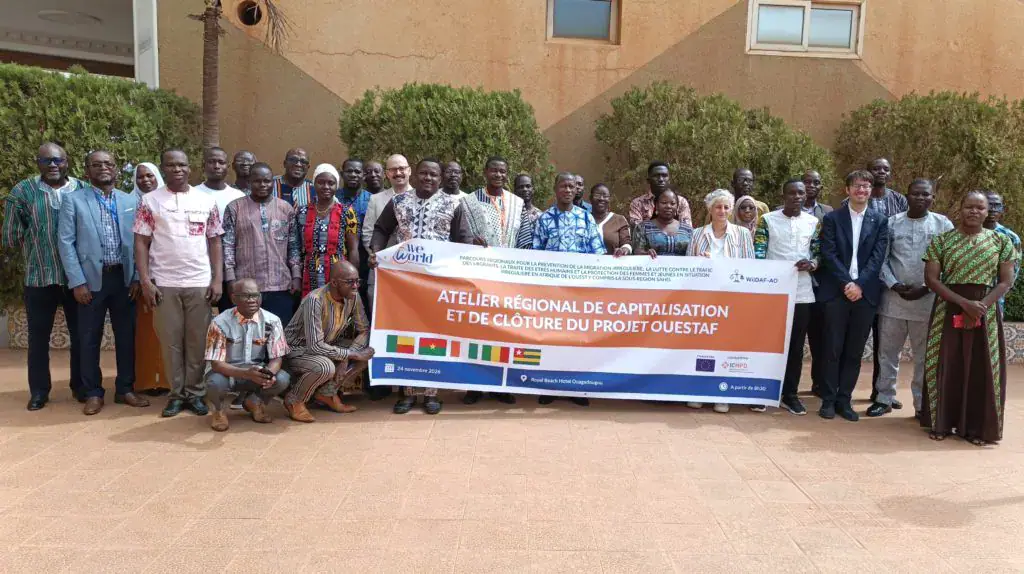
The OUESTAF project, implemented in five West African countries, including Burkina Faso, Mali, Benin, Togo, and Côte d'Ivoire, has officially concluded after 21 months. The project, led by NGO WeWorld and its partners, was funded by the European Union with support from regional partners, including WiLDAF-AO. Its primary objective was to improve migration policies and care for migrants. The project's closure was marked by a regional workshop in Ouagadougou, which brought together stakeholders to review the actions taken.
The project focused on preventing irregular migration, human trafficking, and exploitation. According to Oumarou Sawadogo, the project's leader in Burkina Faso, several coordinated activities were conducted in the five countries. Standard operating procedures and data collection tools were developed to improve migrant care. These instruments were tested through case treatment in the field. The closure workshop aimed to assess the project's achievements, evaluate indicators, and gather recommendations for sustaining the gains.
The project's importance was emphasized by Issaka Pamtam, representing the Minister of Family and Solidarity. He highlighted the risks faced by individuals engaging in irregular migration, including human trafficking, exploitation, violence, and human rights violations. Women, young girls, and children are particularly exposed to these risks. Pamtam stressed that addressing these challenges requires migration governance that prioritizes human dignity, protection, and respect for rights.
The European Union provided significant funding for the project, totaling 1,516,293.18 euros. Béatrice Campodonico, representing the EU Delegation, noted that migration can be both an opportunity and a challenge. The EU supported OUESTAF to improve migration governance and management in West Africa and the Sahel region. The project aimed to protect women and young people, who are vulnerable to irregular migration risks.
The project's achievements and challenges were reviewed during the closure workshop. Stakeholders discussed the project's impact and identified areas for improvement. Recommendations from the workshop will help consolidate the project's gains and ensure continuity in migration governance and protection.
The OUESTAF project's conclusion marks the end of 21 months of activities in five beneficiary countries. The project's outcomes and lessons learned will inform future initiatives aimed at addressing irregular migration and promoting effective migration governance. The project's partners and stakeholders are expected to build on the momentum generated by OUESTAF.
The project's legacy will depend on the implementation of the recommendations from the closure workshop. The stakeholders will work together to ensure that the gains made are sustained and that the project contributes to long-term improvements in migration governance and protection in West Africa. The project's impact will be closely watched by regional and international stakeholders.
Key points
- The OUESTAF project was funded by the European Union with a grant of 1,516,293.18 euros.
- The project was implemented in five West African countries: Burkina Faso, Mali, Benin, Togo, and Côte d'Ivoire.
- The project's primary objective was to improve migration policies and care for migrants in the region.