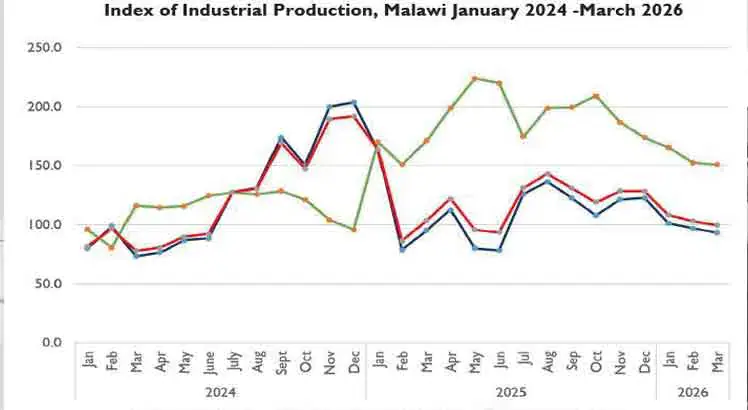
Malawi's industrial production has continued to face challenges this year, with the manufacturing sector being the primary cause of the decline. According to the National Statistical Office (NSO) Index of Industrial Production, manufacturing recorded a negative contribution of 11.8 percentage points to the annual average growth rate of industrial production. This significant decline has had a ripple effect on the overall industrial sector, with an overall negative contribution of 12.1 percentage points.
The decline in manufacturing production was largely driven by specific sectors, including tobacco manufacturing, which contributed minus 13.6 percentage points. Additionally, rubber and plastics products contributed minus 6.1 percentage points, while chemical products contributed minus 2.7 percentage points. These declines have resulted in a substantial decrease in production across various industrial categories.
The NSO data also shows that most industrial categories recorded a decline in production during the period. Notably, rubber and plastics products fell by about 84 percent, while tobacco products declined by 28.7 percent. Furthermore, electricity and water production decreased by 4.7 percent, exacerbating the challenges faced by the industrial sector.
Trade expert Paul Kwengwere has commented on the situation, stating that the decline exposes critical vulnerabilities in Malawi's business ecosystem. He emphasized that the manufacturing and industrial sectors are bearing the brunt of ongoing structural shocks. Kwengwere stressed that stabilizing the macroeconomic environment, specifically exchange rate predictability and utility reliability, is crucial for any industrial recovery to take root.
According to Kwengwere, the contraction in the manufacturing sector dampens Malawi's near-term economic recovery prospects, shifting the burden onto other sectors. He highlighted that sectors such as rubber and plastics rely heavily on external inputs, which are functionally paralyzed by the foreign exchange shortage. Moreover, the domestic infrastructure meant to support these businesses is shrinking rather than expanding.
Ronald Ngwira, president of the Malawi Confederation of Chambers of Commerce and Industry (MCCCI), shared his concerns about the recovery process, stating that it will be a long and painful journey. He emphasized the need for deliberate and intentional paradigm shifts to address the challenges faced by the industrial sector. Ngwira also noted that Malawi is facing significant headwinds that have long-term effects on productivity and competitiveness.
The MCCCI Business Climate Survey found that most firms are operating below capacity, with 51.9 percent operating below 50 percent utilization. Only 11.1 percent of firms are operating above 75 percent capacity. The industrialization pillar in Malawi 2063 aims to transform the country into a productive, export-oriented, and self-reliant economy by 2030 and an upper-middle-income economy by 2063. However, achieving this goal will require addressing the current challenges and implementing necessary reforms.
Key points
- Malawi's manufacturing sector recorded a negative contribution of 11.8 percentage points to the annual average growth rate of industrial production.
- The decline in manufacturing production was driven by sectors such as tobacco, rubber, and plastics products.
- The industrial sector's struggles are expected to have a long-term impact on Malawi's economic recovery and competitiveness.