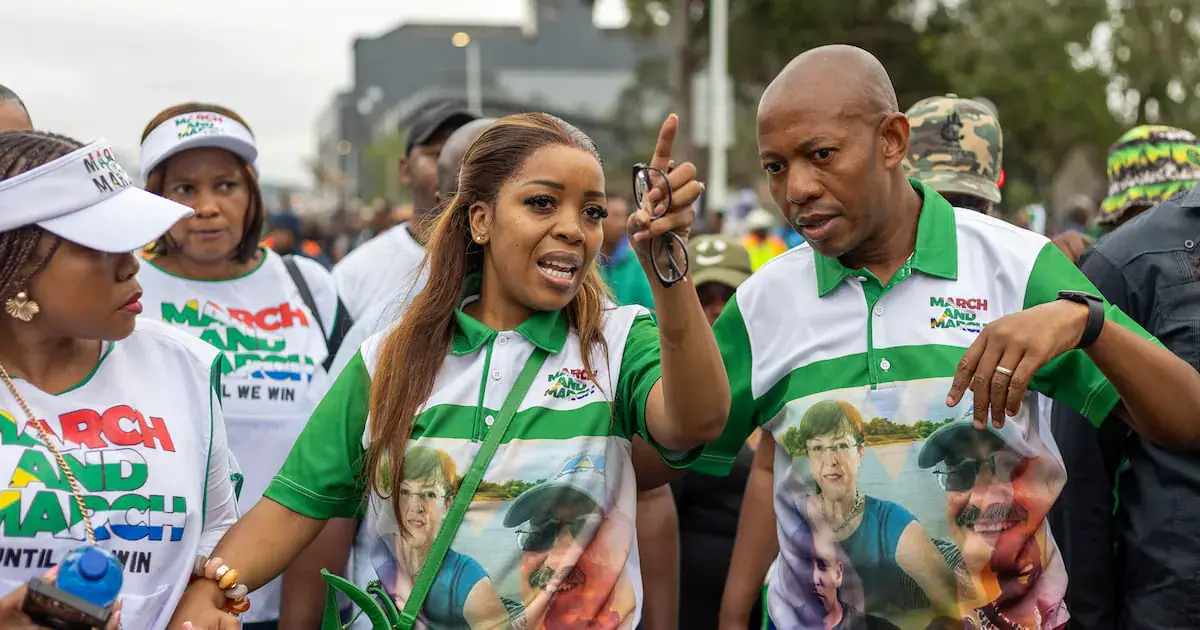
The Durban high court is to hear a case against March and March founder Jacinta Ngobese-Zuma, who faces allegations of inciting unrest. This comes after Police Minister Firoz Cachalia and KwaZulu-Natal Provincial Commissioner Lt-Gen Nhlanhla Mkhwanazi filed an urgent interdict against Ngobese-Zuma, her husband Xolani, and other respondents. The interdict aims to prevent them from convening, organising, directing, or mobilising marches or protest convoys in affected areas.
The urgency of the interdict is based on intelligence around an alleged threat to burn down the home affairs refugee reception centre, alongside fears of retaliation after the killing of a foreign national in the Durban CBD last week. However, March and March spokesperson Sandile Dube accused the police minister of using the movement as a "scapegoat for policing failures" and relying on rumours to justify the interdict. Dube dismissed the intelligence about a possible arson attack as false.
The case against Ngobese-Zuma and March and March brings the relationship between political mobilisation and violence before the Durban high court. The city is still reeling from the memories of 354 deaths and an estimated R50bn in damage during the July 2021 riots. The proposed relief in the interdict also seeks prohibitions on assault and harassment, looting, arson, damage to property, and attacks on home affairs premises.
Despite the interdict, Ngobese-Zuma posted on Facebook that she would appear in court on Friday, 30 October 2026, and vowed to march after the court appearance. The Siyafana Sonke Action Campaign, a coalition of about 190 civic organisations, welcomed the police legal action, saying the Constitution extends its protection to all persons within South Africa's borders.
The Durban CBD has been on high alert for several months following ongoing anti-migration and xenophobic attacks. Last month, Premier Thami Ntuli called in the army to quell the violence. Despite the army's presence, Durban has continued to experience daily protests and violent flare-ups. KwaZulu-Natal police spokesperson Col Robert Netshiunda said four men appeared in court in connection with the attacks on foreign nationals in the city.
President Cyril Ramaphosa addressed the uncertainty facing businesses at the Durban Chamber of Commerce and Industry's 170th anniversary dinner. He confirmed that he extended the army deployment, which was due to end at the end of October, until the end of November. Ramaphosa also acknowledged that there are those who exploit public sentiment around illegal migration to stir up communities and provide cover for criminality.
The case against Ngobese-Zuma is separate from the case against Duduzile Zuma-Sambudla, who faces one count of incitement to commit terrorism and two counts of incitement to commit public violence. Zuma-Sambudla, a former MKP MP, allegedly made social media posts during the July 2021 riots that encouraged violence. Her legal representative, Adv Dali Mpofu, challenged the credibility of the investigating officer, Bheki Nazo, and put it to him that the prosecution was a political plot to tarnish his client and her father, former President Jacob Zuma.
Key points
- The Durban high court is set to hear a case against March and March founder Jacinta Ngobese-Zuma for allegedly inciting unrest.
- The case brings the relationship between political mobilisation and violence before the Durban high court.
- President Cyril Ramaphosa extended the army deployment in KwaZulu-Natal until the end of November to quell ongoing violence.