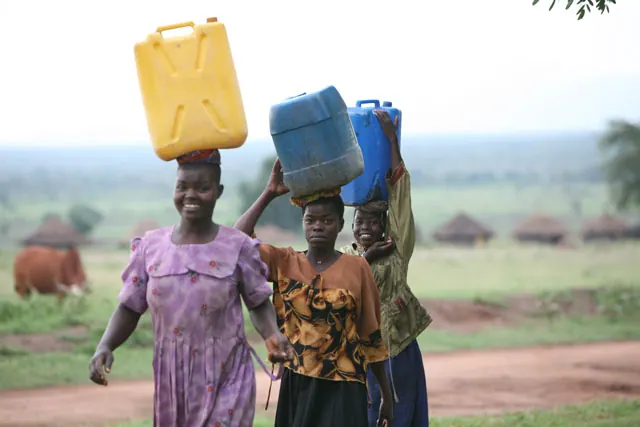
Uganda's water sector has made measurable progress, with national access to safe water increasing from 71.2% to 73.6%, surpassing the annual target. However, lawmakers have warned that there is a deeper crisis in which entire communities remain without reliable safe water. According to the Ministry of Water and Environment, over 12,000 villages and cells still lack an improved water source.
The Ministry of Water and Environment reported that rural water access stands at 72%, urban coverage at 75.2%, and access in refugee-hosting communities at 76%. Functionality remained relatively high, at 85% in rural areas, 92% in urban centers, and 91% in refugee settlements. The government also rehabilitated 27 piped-water systems and 1,238 rural point-water facilities, restoring reliable supply to an estimated 464,000 people.
Despite progress, lawmakers argue that the gap in access to safe water cannot be treated as a statistical residue when water scarcity directly shapes public health, education, livelihoods, and resilience to drought. Napak District Woman MP, Faith Nakut, emphasized that the distinction between rural and urban communities should not determine whether a household can access a nearby safe water connection.
Nakut also pointed to incomplete rural water projects in Karamoja, citing projects in Iriri, Lorangachora, and Apitolim, which have remained unfinished for years. Uganda's water challenge is not simply one of expanding infrastructure, but also one of project delivery, supervision, maintenance, and value for money. Pakwach District Woman MP, Jane Avur Pacuto, highlighted the irony of her constituency being surrounded by water bodies while many residents lack safe and clean water.
Pacuto called for greater public investment in the water sector, citing the burden of bilharzia associated with unsafe water in Panyimur Town Council. She also noted that many schools in Pakwach share water points with surrounding communities, a situation she described as both unsafe and disruptive to school administration. Budadiri East MP Julius Muntu Nakiyi emphasized that some of Uganda's water infrastructure is being asked to serve populations far larger than those for which it was originally designed.
Nakiyi explained that in designing water systems, factors such as population and consumption per capita determine the size of storage tanks, pipe networks, gradients, and flow rates. He expressed concern that some gravity-flow schemes may now be operating beyond their intended design capacity. Ntoroko County MP Edison Rugumayo described the situation in Ntoroko as severe, with one of the highest proportions of villages without access to safe water.
The Ministry of Water and Environment reported progress in environmental and water monitoring, including the commissioning of 11 automatic weather stations, bringing the national network to 234 stations across 104 districts. Water-use permit compliance reached 81%, while wastewater-discharge compliance stood at 49.2%. The ministry also reported that Uganda restored 26,709.6 hectares of degraded forests and landscapes during the financial year, exceeding the 20,000-hectare target.
Key points
- One in six villages in Uganda still lack access to safe water despite progress in the water sector.
- Lawmakers are calling for greater public investment in the water sector to address the gap in access to safe water.
- Uganda's water challenge is not just about expanding infrastructure, but also about project delivery, supervision, maintenance, and value for money.