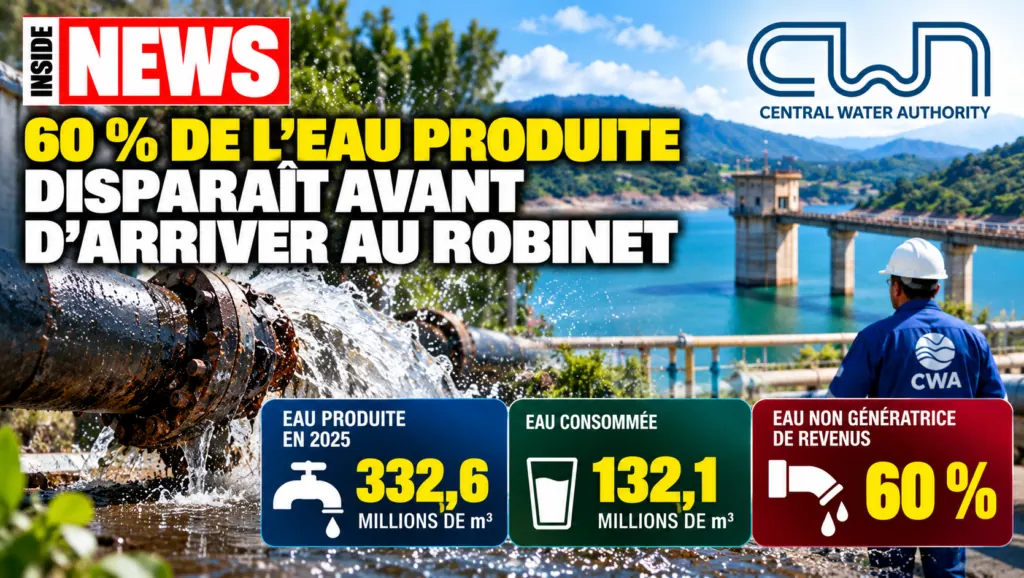
The Central Water Authority (CWA) of Mauritius produced 332.6 million cubic meters of water in 2025, but only 132.1 million cubic meters were recorded as consumed. The remaining 200.5 million cubic meters, approximately 60% of production, is classified as non-revenue water. This significant loss is attributed to various factors, including physical leaks, overflows, meter errors, illegal connections, and unmeasured consumption.
The CWA's annual report for 2024-2025 highlights the issue of aging infrastructure as a major problem. A program to replace around 500 kilometers of critical pipelines was initiated in the last quarter of the 2022-2023 financial year. Additionally, approximately 115 kilometers of pipes over 50 years old are being addressed through a program funded by a line of credit from the Indian government.
Despite significant investments in pipeline replacement programs, the Audit Office's report notes that no improvement in non-revenue water was recorded between 2024 and 2025. By June 30, 2025, nearly Rs 2 billion had already been invested in these programs. This suggests that the challenge of water losses in Mauritius remains substantial.
A review of public documents reveals that there is no single, consistent series of data covering each year from 2010 to 2026. Reports sometimes use different indicators, such as capital expenditures, disbursements for pipelines, fixed assets, and works financed by loans or actual expenses. However, verifiable figures show that investments in the water sector have been ongoing.
Between 2010 and 2013, the focus was mainly on disbursements related to pipelines, which are not directly comparable to capital expenditures in later years. The 2013 annual report indicated that Rs 549.8 million was spent against a budget of Rs 885 million. In 2015, the CWA's annual report stated that Rs 794.7 million was spent on capital expenditures, against a revised budget of Rs 2.056 billion.
The current government's budget for 2026-2027 allocates Rs 175 million to equip around 11,000 households with reservoirs and accessories to improve supply continuity. Additionally, Rs 6.4 billion is allocated over three years to increase national abstraction capacity and improve distribution. This includes projects such as the Rivière-des-Anguilles dam, twenty new boreholes, pipeline replacements, and fifteen additional filtration units.
The persistence of significant water losses in Mauritius highlights the need for continued efforts to address infrastructure weaknesses and improve the efficiency of the water supply system. While investments have been made, the lack of progress in reducing non-revenue water suggests that more needs to be done to ensure that produced water reaches consumers.
Key points
- 60% of produced water is lost before reaching consumers in Mauritius.
- The CWA has invested significantly in pipeline replacement programs, but no improvement in non-revenue water has been recorded.
- The government has allocated additional funds to improve water supply continuity and distribution in the 2026-2027 budget.