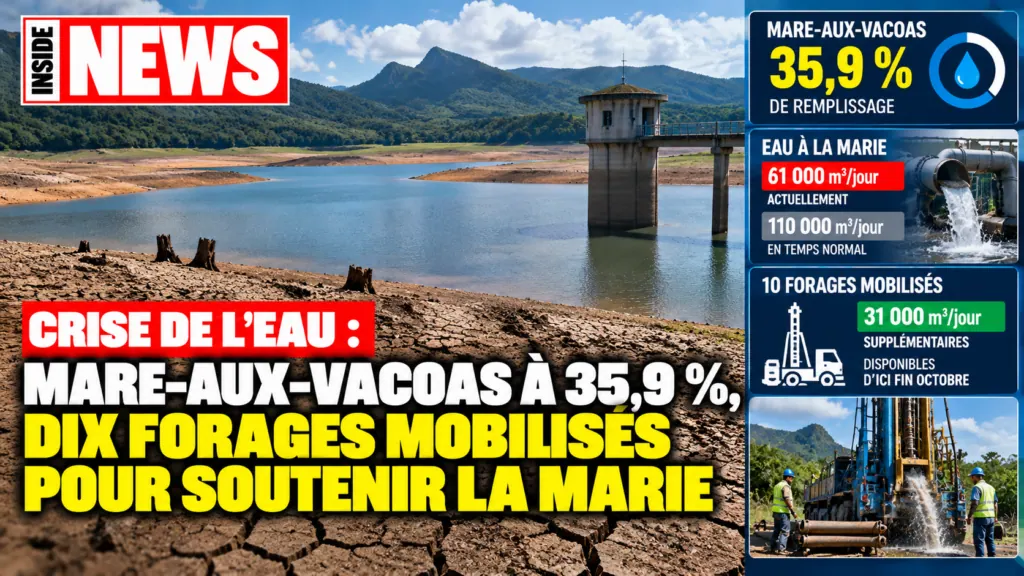
The water crisis in Mauritius has taken a turn for the worse as the country's main water reserve, Mare-aux-Vacoas, continues to decline. As of the latest readings, the reservoir is only 35.9% full. This significant drop has directly impacted the La Marie water treatment plant, which is now receiving only 61,000 cubic meters of water per day, a substantial decrease from the usual 110,000 cubic meters.
The reduced water supply to La Marie has created a considerable deficit, affecting the plant's ability to meet the water demands of the region. In response, the government has announced plans to deploy 10 boreholes in the affected areas to supplement the water supply. The aim is to extract an additional 31,000 cubic meters of water per day, which will be reinjected into the network to partially offset the deficit at La Marie.
However, this solution is not immediate, as the additional capacity is expected to be available only by the end of October. Even if the 10 boreholes meet their target, they will not fully compensate for the shortfall in water supply from Mare-aux-Vacoas. The government faces a daunting task in managing the water reserves until the onset of significant summer rains, expected only in the second half of December.
The situation requires careful management of the remaining water reserves, balancing conservation with the needs of households and economic activities. The authorities must make tough decisions to ensure a fair distribution of the limited water resources. Meanwhile, the official schedules of the Central Water Authority (CWA) remain in effect for consumers.
The water crisis in Mauritius has escalated into a critical phase, with the country's strategic water reserve continuing to dwindle. The government is working to mitigate the effects of the drought, but the situation remains challenging. The impact of the water shortage on various sectors, including households, agriculture, and industry, is a pressing concern.
The deployment of 10 boreholes is part of a broader strategy to address the water crisis. The government is exploring various options to augment the water supply, including the use of alternative sources and efficient distribution systems. However, the long-term solution to the water crisis lies in addressing the underlying issues, including the effects of climate change and the need for sustainable water management practices.
As the water crisis deepens, the Mauritian government is urging citizens to conserve water and use it judiciously. The situation requires a coordinated effort from all stakeholders to ensure that the country navigates this challenging period effectively. The authorities are working to provide support to affected communities and to minimize the impact of the water shortage on daily life.
Key points
- The water crisis in Mauritius has led to the deployment of 10 boreholes to supplement the La Marie treatment plant, which is facing a significant shortfall in water supply.
- The country's main water reserve, Mare-aux-Vacoas, is currently only 35.9% full, prompting concerns about the availability of water until the onset of significant summer rains.
- The government is working to manage the water reserves and distribute the limited resources fairly, while exploring long-term solutions to address the underlying issues.