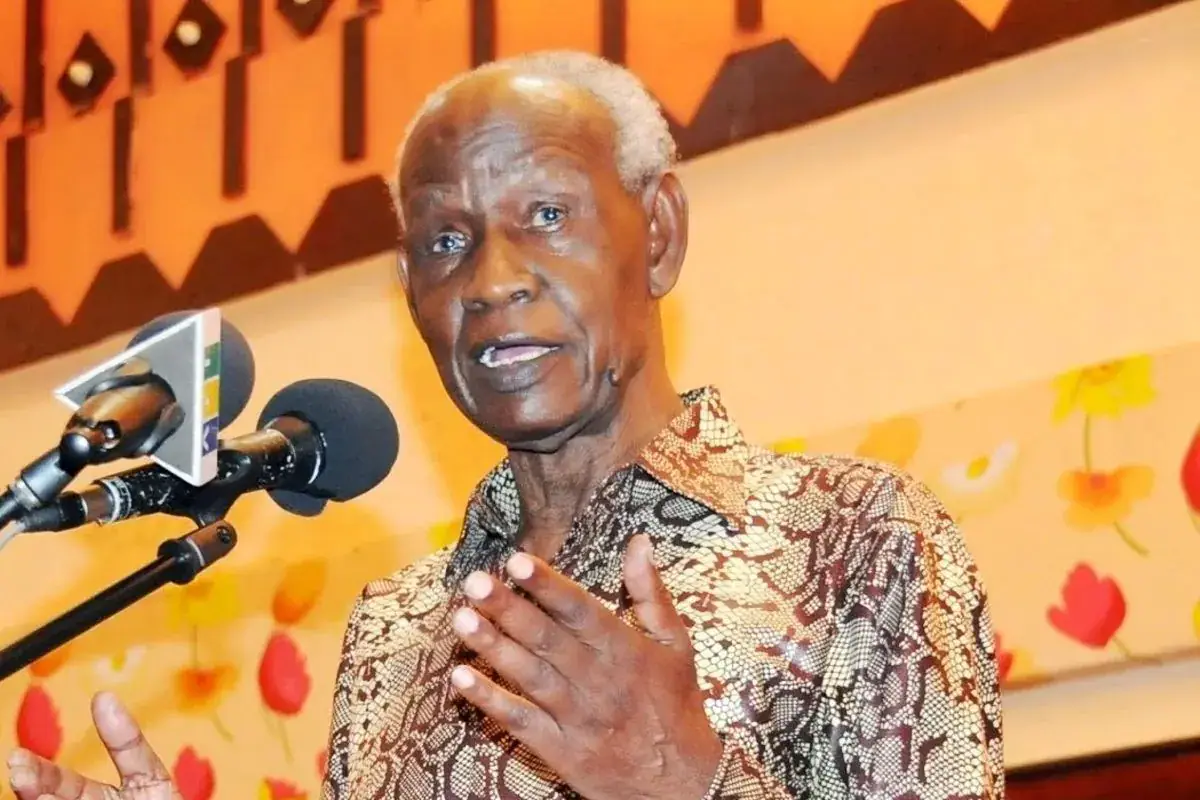
Retired Prime Minister Justice Joseph Warioba has called on the Tanzanian government to immediately initiate constitutional reforms, warning that the remaining three years before the 2028/29 target are insufficient to deliver an entirely new supreme law. He proposes a twin-track approach: enacting targeted constitutional amendments ahead of the 2030 General Election while laying the legal and institutional foundations for a comprehensive new charter. This approach aims to address institutional shortcomings witnessed during the previous General Election.
Justice Warioba's remarks follow President Samia Suluhu Hassan's pledge on November 20, 2026, to have a new or revised Constitution by 2028 or 2029. The President reiterated the ruling Chama Cha Mapinduzi (CCM) commitments in its 2025–2030 election manifesto. Justice Warioba welcomed the President's commitment as an encouraging step but stressed that Tanzania fundamentally needs an entirely new Constitution rather than piecemeal amendments. He argued that immediate action is essential to address institutional shortcomings.
Justice Warioba explained that drafting and adopting a new constitutional text is only part of the process, noting that aligning existing laws and overhauling governance institutions would take considerable time. He emphasised that acquiring a new Constitution is an intricate process requiring parallel changes to existing laws and the institutions mandated to enforce them. Therefore, he advised that Tanzania should complete critical interim constitutional amendments by 2029 to ensure the 2030 elections are conducted under an improved legal framework.
The veteran statesman noted that historical precedent shows that major changes to Tanzania's governance structure have required entirely new constitutions. Following independence in 1961, Tanganyika retained its British-inherited Constitution until becoming a republic in 1962, necessitating a new supreme law. Another Constitution followed in 1965 when the country formally became a one-party state. The 1964 Union between Tanganyika and Zanzibar was initially expected to produce a permanent Union Constitution within a year, but that milestone was only achieved in 1977.
Justice Warioba reflected on the stalled 2011–2014 constitutional review, during which he chaired the Constitutional Review Commission (CRC) appointed by President Jakaya Kikwete. He said the main obstacle had never been a lack of ideas but insufficient political will. Sharp political disagreements persisted over key provisions in the CRC's second draft, including the structure of the Union, judicial independence, separation of powers, presidential powers and the electoral framework.
Justice Warioba cautioned against leaving the constitutional agenda exclusively to politicians, noting that the supreme law governs the lives and rights of every citizen. He urged political parties to abandon confrontational politics, put national interests above partisan considerations and promote constructive dialogue to build consensus. He emphasised that Tanzania need not start from scratch because public consultations have already established citizens' aspirations.
The previous constitutional review stalled in 2014 after the Constituent Assembly substantially altered key proposals in the Warioba Commission's draft. The changes prompted a boycott by opposition members and several civil society delegates, halting the process before the planned national referendum could take place. Although constitutional debates continued after President John Magufuli took office in 2015, the stalled process was never revived to completion.
Key points
- Justice Warioba proposes a twin-track approach to constitutional reforms in Tanzania.
- The process requires parallel changes to existing laws and institutions.
- Insufficient political will was the main obstacle to the 2011-2014 constitutional review.