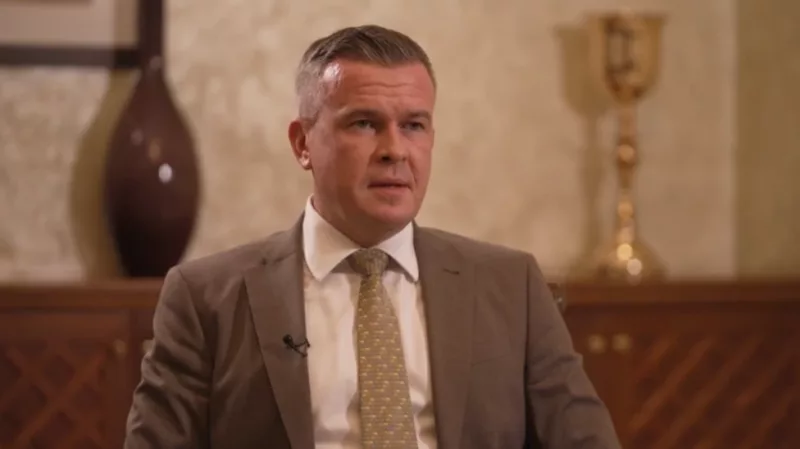
Kenya must demonstrate it can be a "clean" home of athletics if it is to retain its credibility as it prepares to stage the 2029 World Athletics Championships, according to Witold Banka, president of the World Anti-Doping Agency (Wada). Banka was speaking at the end of a three-day visit to Nairobi where he held talks with President William Ruto, government and sports officials, the Anti-Doping Agency of Kenya (Adak), athletes and representatives of law enforcement.
Banka's visit aimed to build on recent progress in Kenya's anti-doping programme at a critical time following Nairobi's selection to host the 2029 World Championships. Kenya was awarded the 2029 championships in September, making it the first African country selected to host the event. The decision has increased scrutiny of its efforts to tackle a long-running doping problem. More than 140 Kenyan athletes, predominantly distance runners, have been suspended by the Athletics Integrity Unit since 2017.
Banka emphasized that Kenya needs to instill a culture of clean sport, stating, "Kenya calls itself probably 'home of champions', but every home has to have a good host and has to be clean to be credible." He received a clear commitment from Ruto's government to a policy of zero tolerance towards doping, but warned promises would have to be matched by results. Wada will monitor the situation and observe the dynamic, as "action speaks louder than words."
Discussions between Banka and Ruto also focused on strengthening an independent Adak, and ensuring it has sufficient government support. The 2029 championships could provide a global test of Kenya's ability to protect its sporting legacy. For a country whose distance runners have helped define global athletics for generations, the stakes extend beyond staging a successful championship.
A significant challenge for Kenya is testing infrastructure. Africa currently has no Wada-accredited doping control laboratory following the loss of accreditation of the facility in Bloemfontein, South Africa. Wada initially suspended the laboratory in March 2024 because of multiple failures to comply with its International Standard for Laboratories. Its accreditation was formally revoked in May 2025 after those problems were not satisfactorily resolved.
Banka said Kenya has shown political interest in establishing its own facility, but cautioned against expecting a laboratory to be accredited in time for the 2029 championships. The process takes years because the consequences of laboratory error can be enormous for an athlete. That leaves Kenya facing a more immediate priority: strengthening the system around testing rather than relying on a new laboratory as a solution.
Banka also rejected the idea that doping should be viewed as an exclusively Kenyan, or African, problem. He pointed to cases across established sporting nations, including the United States, Germany and his native Poland. Banka emphasized that doping has no colours and flags, and that athletes are often the "weakest points in the ecosystem", arguing that anti-doping authorities need to pursue not only competitors who break the rules but also the coaches, doctors, managers and suppliers who enable doping.
Key points
- Kenya must demonstrate it can be a "clean" home of athletics to retain credibility ahead of 2029 World Athletics Championships.
- Wada president Witold Banka received a clear commitment from President William Ruto's government to a policy of zero tolerance towards doping.
- Kenya faces significant challenges in testing infrastructure, including a lack of Wada-accredited doping control laboratories in Africa.