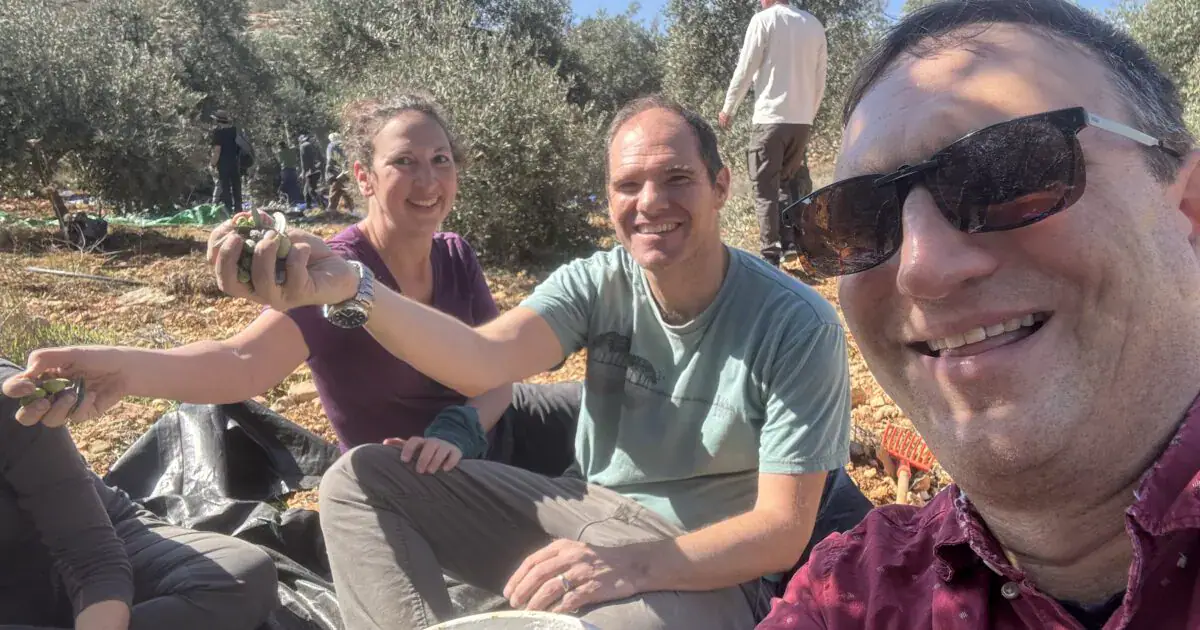
In the West Bank, Palestinian farmers face increasingly violent attacks by extremist Jewish settlers during the olive harvest season. To deter these attacks, a group of Israeli and international volunteers joined Palestinian families to provide a protective presence during the harvest. This approach, known as "protective presence," aims to uphold the rights of Palestinian families to their property and livelihood. The volunteers, led by Rabbis for Human Rights, converged on a valley south of Bethlehem at the invitation of Palestinian families.
The volunteers, including Professor David Bilchitz, a professor of Fundamental Rights and Constitutional Law, worked alongside Palestinian farmers to harvest olives. Despite being a university professor, Bilchitz learned to pick and rake olives, and the group separated the olives according to informal demarcations among the families. The volunteers demonstrated an active commitment to upholding the rights of Palestinian families and the rule of law. Their presence made the harvest possible, as Palestinian families were terrified to harvest their olives due to the risk of violence.
The olive harvest took place in a valley surrounded by small outposts on hills where extremist settlers had set up homes illegally. The Palestinian families told the volunteers that they were grateful for their presence, which had made the harvest possible. The volunteers, mostly diaspora Jewish and Israeli, showed camaraderie and a conviction that the fear and violence Palestinian farmers faced was wrong. Their actions aimed to defend the fundamental rights of Palestinian families and uphold Jewish tradition.
However, the following day, in Qusra, near Nablus, the harvest site was attacked by extremist settlers. Volunteers who had worked with Bilchitz the previous day reported that masked men suddenly descended from a hilltop and started beating people in the fields with clubs. A video showed one of the masked men beating and another kicking an elderly woman, resulting in six injuries, including a head injury and bruised eye.
The Israeli military and police were present during the attack but failed to arrest the attackers, despite their guilty actions. This incident highlighted the current state of impunity for extremist settlers. The outgoing far-right government has enabled a major increase in illegal hilltop settlement activities and allowed the violence to continue. Bilchitz emphasized that one of the first actions of a new Israeli government must be to end settler violence.
The incident and others like it underscore the need for a commitment to upholding the rights of Palestinian families and the rule of law. Small acts by individuals, such as the volunteers' actions, can build trust, partnership, and collaboration. By standing together, Jews and Palestinians can work towards a different reality, one where both peoples can live side by side in peace.
The olive harvest, an ancient agricultural activity common to many peoples across the Middle East, has become a symbol of resistance and resilience for Palestinian farmers. The volunteers' actions demonstrate that, even in the face of violence and impunity, individuals can make a difference by standing up for the rule of law and human rights.
Key points
- Ending settler violence is a necessary step towards a peaceful future for Israel and Palestine.
Reporting sources
- Shifting the Israeli-Palestinian reality olive by olive · Jewish Report