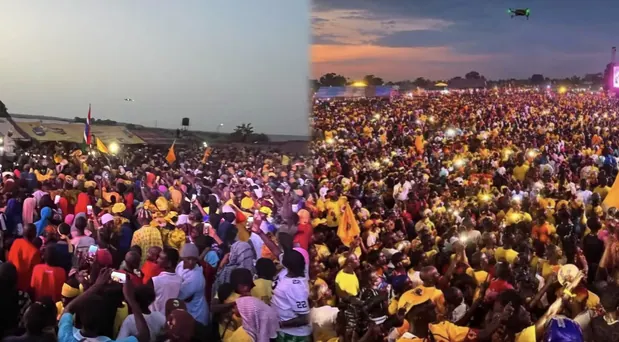
On September 12, 2026, The Gambia's main opposition party, the United Democratic Party (UDP), held a rally in Allunhari village, a stronghold of the ruling National People's Party (NPP). A Facebook user, UDP TV & MEDIA, shared an image that appeared to show an unusually large crowd at the event. The image was accompanied by a video in which a UDP supporter claimed it was genuine and rejected suggestions that it had been generated using artificial intelligence.
The supporter, who identified himself as a UDP supporter, stated that the turnout showed growing dissatisfaction with President Adama Barrow's leadership and support for UDP's leader, Ousainou Darboe. The post had attracted over 1,500 likes, 41 comments, and 23 shares at the time of writing. Several commenters believed the image was authentic, and some suggested the turnout reflected growing support for the opposition party ahead of The Gambia's presidential election on December 5, 2026.
Dubawa, a fact-checking organization, examined photographs and videos taken during the UDP rally in Allunhari and compared them with the image shared by UDP Media and TV. The comparison revealed significant inconsistencies between the image in question and real-life images taken at the rally. Several visual features in the image raised concerns, including distorted or poorly defined faces, unnatural spacing and positioning of people, and difficulty distinguishing hands and other body parts.
Using an Artificial Intelligence detection tool, aiornot.com, Dubawa obtained an 85 percent probability that the image was digitally manipulated. Other AI detection tools, such as Canva AI, DeepAI, and ZeroGPT, also showed that the image was AI-generated. A Dubawa fact-checker, Dawda Baldeh, who was physically present at the Allunhari rally, examined the image against the scene observed at the event and found it to be inconsistent.
The video footage recorded by the fact-checker provided visual evidence for comparison. Dubawa also reviewed other photographs published by the claimant in connection with the rally, which were consistent with the available visual realities and did not exhibit the same characteristics associated with the AI-generated image. The fact-checking organization concluded that the image did not accurately depict the crowd at the event.
The image in question was shared by UDP TV & MEDIA, a Facebook user with a significant following. The post was shared widely, and several commenters believed the image was authentic. However, Dubawa's fact-checking revealed that the image was not genuine. The organization's research indicates that the image was AI-generated and does not accurately depict the crowd at the event.
The finding highlights the growing concern about the use of AI-generated images in social media, particularly in the context of political rallies and elections. It also underscores the importance of fact-checking and verifying information before sharing it widely. The UDP rally in Allunhari was a significant event, and the accurate representation of the crowd is crucial for understanding the public's response to the party's message.
Key points
- The image of a massive crowd at the UDP rally in Gambia's Upper River Region was found to be AI-generated.
- The image was shared by UDP TV & MEDIA on Facebook and had attracted over 1,500 likes and 41 comments at the time of writing.
- Dubawa's fact-checking used AI detection tools and compared the image with real-life photographs and videos taken at the rally.