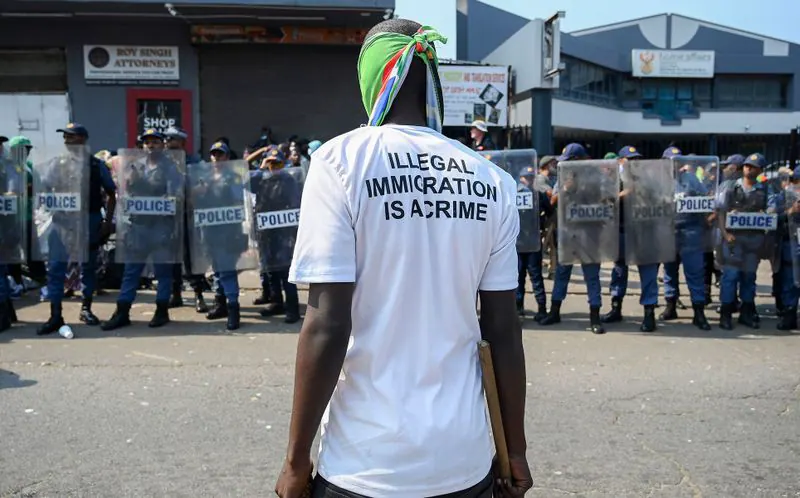
Violent protests broke out in Durban and Soweto, South Africa, on October 6 and 8, 2026, following widespread misinformation about a Home Affairs directive on asylum seekers. The protests, led by groups such as March and March, resulted in 24 cars being torched, injuries, and looting of foreign-owned shops. The unrest was sparked by a Constitutional Court ruling in July 2026, which declared certain provisions of the Refugees Act unconstitutional and invalid. The ruling required the removal of procedural barriers to lodging an asylum claim.
The Constitutional Court ruling, issued in July 2026, found that specific procedural barriers to lodging an asylum claim must be removed. The Refugees Act required asylum seekers to enter South Africa through a designated port of entry to receive an asylum transit visa, which is valid for five days. The court ruled that these procedural barriers could prevent genuine asylum seekers from accessing a merits-based assessment of their claim, particularly given the constitutional right to dignity and the principle of non-refoulement.
On September 28, 2026, Home Affairs issued a directive instructing refugee reception offices to receive people who report in person and indicate that they intend to apply for asylum, and to help them lodge their applications. The directive applied to people who had entered the country unlawfully, had entered somewhere other than a designated port of entry, did not have a visa, or had failed to report to one of the country’s five offices within five days. This directive was misinterpreted by anti-foreigner groups, who claimed it would give foreign nationals "free will" to seek asylum.
The uproar over the asylum ruling and directive comes amid a growing wave of anti-foreigner mobilisation in South Africa. Groups such as March and March have been at the forefront of demonstrations throughout 2026, culminating in a June 30 "deadline" for foreign nationals to leave the country. The violence has resulted in the destruction of homes and businesses, the displacement of communities, and people fleeing the country. March and March leader Jacinta Ngobese-Zuma has emerged as a prominent figure in the mobilisation.
Ngobese-Zuma described the court ruling as "absolutely shocking" and argued that the recent Home Affairs directive would give foreign nationals "free will" to seek asylum and place further pressure on the country’s finite resources. She and others used the Home Affairs directive to further their claims that illegal migration is responsible for a wide variety of South African problems – unemployment, crime, healthcare, and education.
On October 9, 2026, the director-general of the Department of Home Affairs withdrew the directive, stating that the department would start from scratch to draft a sustainable plan that meets the requirements set by the Constitutional Court. The Inter-Ministerial Committee on Migration reasserted that the court’s judgment does not automatically grant refugee status or permanent residence, nor does it legalise unlawful migration.
The committee also addressed the misinformation surrounding the ruling, warning that false or sensational claims could fuel social tensions and undermine confidence in public institutions. Despite this, anti-immigrant groups and some political figures have used the judgment and directive to amplify anti-immigrant sentiment in South Africa. Many widely circulating claims from anti-migrant groups are unsupported by evidence.
Key points
- The Constitutional Court ruling declared certain provisions of the Refugees Act unconstitutional and invalid.
- The Home Affairs directive was misinterpreted by anti-foreigner groups, leading to violent protests.
- The protests resulted in 24 cars being torched, injuries, and looting of foreign-owned shops.