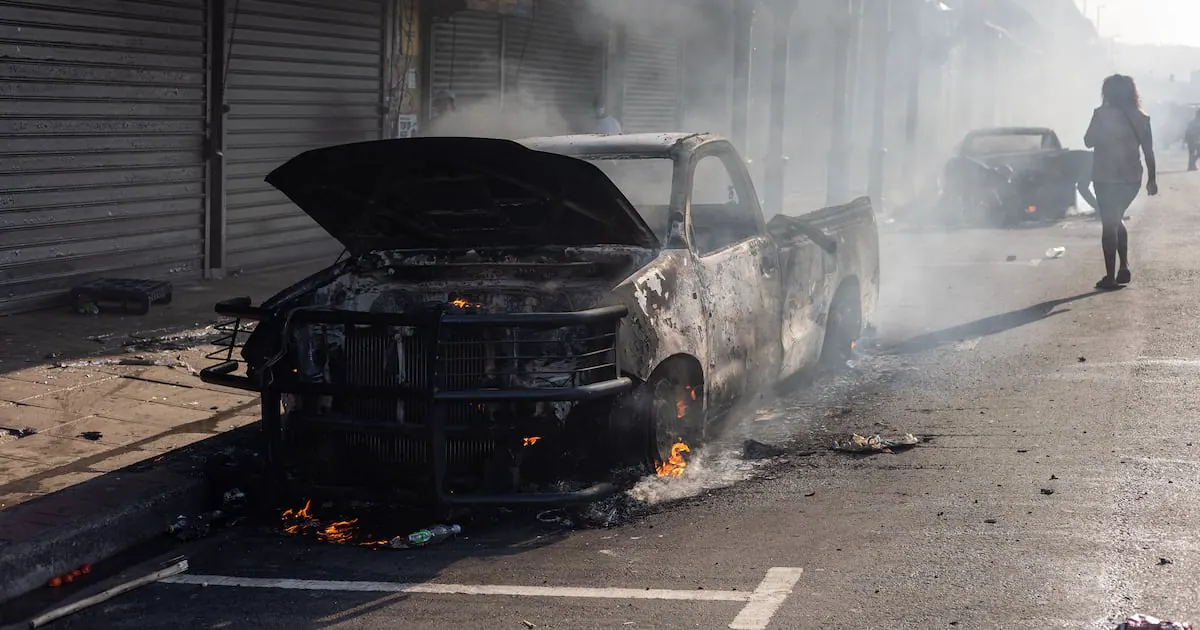
Widespread violence and public unrest erupted in several cities across South Africa on Thursday, including Durban, where protesters torched at least 10 cars and set a building alight in the central business district. The violence sparked fear and public ire, with the US Consulate in Durban issuing a warning to its citizens to exercise extreme caution in the area. The consulate advised people to avoid the area, crowds, and demonstrations, and to remain aware of their surroundings.
The violence followed a national day of anti-migrant protest, with protesters clashing with foreigners in various parts of the country, including Hillbrow, Orlando East, Flagstaff, Epping, and Durban. The protests were sparked by the department of home affairs' decision to reopen its asylum system to new applicants. The US Consulate General in Durban said it was aware of reports of unrest near the Bayside Hotel and instructed US government personnel to exercise extreme caution in the area.
In Durban, residents and businesses took cover as protesters went on the rampage, storming shops and setting vehicles alight. A Sunday Times team witnessed an incident in which a foreign national was sjamboked on Russell Street. KwaZulu-Natal police spokesperson Col Robert Netshiunda said three foreigners were arrested in connection with the alleged assault of a demonstrator. Police fired rubber bullets and tear gas to disperse violent crowd members, who hurled debris and stones at them.
The police were stretched thin, with several demonstrations taking place simultaneously, including a March and March protest outside a home affairs refugee office against asylum seekers and a gender-based-violence awareness protest. Police were kept on their toes well into the night as sporadic groups of protesters caused disruptions in various areas. In Durban's Che Guevara Road, March and March held a vigil outside the home affairs office, with activist Wandile Nsibande saying they would not allow it to open and process asylum applications.
The Democratic Alliance's eThekwini mayoral candidate, Haniff Hoosen, criticized the police for being ill-prepared for the violence and said protesters should be held accountable for their actions. He also called for scrutiny of how marches are managed and said organisers should take responsibility for damage to property. Hoosen warned that repeated disorder could damage the city's reputation and discourage investment.
Other organizations, including ActionSA and Siyafana Sonke, condemned the violence and called for government to take responsibility for restoring public confidence in the rule of law. ActionSA provincial chairperson Zwakele Mncwango said the party was not part of Thursday's protest and strongly condemned violence, intimidation, and anarchy as a means of resolving differences. Siyafana Sonke activists documented cases of violence and intimidation perpetrated by vigilantes targeting foreign nationals in the Durban CBD.
The violence has raised concerns about the ability of local public protection forces to cope with the extensive violence and the measures being put in place to strengthen public protection. The organisation questioned whether the poor efforts to prevent hate speech, incitement to violence, intimidation, and misinformation were driving the vigilante violence. The incidents have sparked a renewed call for government to address the issues of immigration and asylum seekers in a more effective and sustainable manner.
Key points
- The violence was sparked by the department of home affairs' decision to reopen its asylum system to new applicants.
- The US Consulate in Durban issued a warning to its citizens to exercise extreme caution in the area.
- The police were stretched thin, with several demonstrations taking place simultaneously across the city.