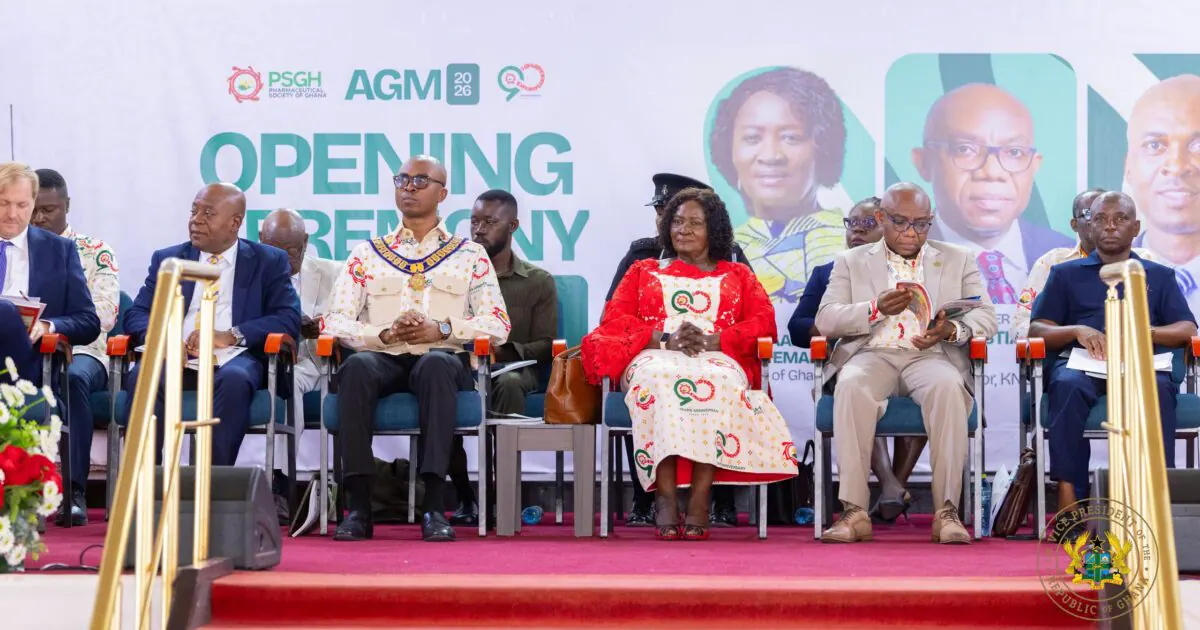
Vice President Professor Naana Jane Opoku-Agyemang has emphasized the need for stronger local pharmaceutical production in Ghana to reduce the country's reliance on imported medicines. Speaking at the 90th Anniversary Annual General Meeting and Scientific Conference of the Pharmaceutical Society of Ghana in Accra, she noted that expanding the capacity of Ghanaian pharmaceutical manufacturers would strengthen the health system and help the country respond more effectively to changing healthcare needs.
The Vice President acknowledged that local manufacturers were already building capacity to produce a wider range of essential medicines and pharmaceutical products, including infusions, injectables, ophthalmic products, and anaesthetics. She said increasing local production would not only strengthen the pharmaceutical industry but also improve access to essential medicines. The government is pursuing a five-year strategy to increase the proportion of medicines manufactured locally from 30% to 70%.
President of the Pharmaceutical Society of Ghana, Pharm. Paul Owusu Donkor, welcomed the 70% target but said achieving it would require sustained government support. He called for predictable public procurement of quality-assured medicines manufactured in Ghana, timely payment of suppliers, and access to affordable long-term financing for pharmaceutical manufacturers. These measures, he said, would give local producers greater certainty to invest in production capacity and contribute to the government's target.
Beyond pharmaceutical manufacturing, Professor Opoku-Agyemang urged pharmacists to play a greater role in addressing Ghana's growing burden of chronic and non-communicable diseases. She also called for regulation to keep pace with technological changes affecting healthcare, including artificial intelligence, digital prescribing, and evolving medicine supply chains. The Vice President said Ghana's changing health needs require a health system capable of detecting diseases early, managing conditions effectively, and preventing avoidable complications.
The conference, held under the theme "Science. Impact. Legacy: 90 Years of Pharmaceutical Excellence," provided a platform for discussions on the future of Ghana's pharmaceutical sector, access to medicines, and measures to build greater resilience within the health system. The 90th anniversary event brought together stakeholders to reflect on the progress made in the pharmaceutical industry and chart a course for the future.
The Vice President's call for stronger local pharmaceutical production is part of a broader effort to improve Ghana's healthcare system. The government is working to strengthen the health system and improve access to essential medicines. The Pharmaceutical Society of Ghana has a crucial role to play in achieving this goal, and the Vice President's address served as a call to action for the industry to work towards a more sustainable and self-sufficient future.
Key points
- The government aims to increase the proportion of medicines manufactured locally from 30% to 70% over the next five years.
- Local manufacturers are developing capacity to produce infusions, injectables, ophthalmic products, and anaesthetics.
- The Pharmaceutical Society of Ghana has called for sustained government support, including predictable public procurement and access to affordable financing, to achieve the 70% target.