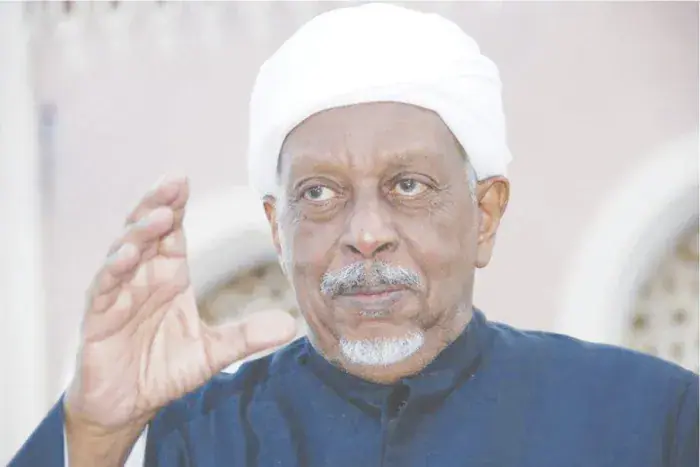
Mohamed Osman al-Mirghani, a veteran Sudanese political and religious leader, has died in Egypt at the age of about 90. The Sudan's Council of Ministers described al-Mirghani as a prominent national and religious figure who played a significant role in the country's political life, particularly in efforts to promote national unity, peace, and political consensus. The council extended its condolences to his family, members and supporters of the Democratic Unionist Party (DUP), followers of the Khatmiyya order, and the Sudanese people.
Al-Mirghani was among Sudan's most influential traditional political and religious leaders, drawing support from the DUP and the Khatmiyya, one of the country's major Sufi movements. He belonged to a prominent religious family that has played a major role in Sudanese public life for generations. Al-Mirghani inherited leadership of the Khatmiyya order following the death of his father, Ali al-Mirghani, in 1968.
Al-Mirghani assumed leadership of the main DUP faction in 1982, following the death of Sharif Hussein al-Hindi. Under his leadership, the party remained a significant force in Sudanese politics, although it experienced internal divisions and shifting political alliances. One of al-Mirghani's most significant political initiatives came in November 1988, when he met John Garang, leader of the Sudan People's Liberation Movement (SPLM), in Addis Ababa, Ethiopia.
The meeting with Garang produced the Mirghani-Garang Agreement, a peace initiative aimed at ending Sudan's second civil war. The agreement proposed a ceasefire, the suspension of the September 1983 Islamic laws pending a constitutional conference, and a broader political process to address Sudan's constitutional crisis. However, the initiative was overtaken by the military coup of June 1989, which brought Omar al-Bashir to power.
Following the 1989 coup, the DUP joined the National Democratic Alliance (NDA), an umbrella coalition of political parties and armed movements opposed to al-Bashir's government. Al-Mirghani became chairman of the alliance and spent extended periods outside Sudan, particularly in Egypt. His relationship with the government later shifted towards political accommodation, and in 2005, he signed a reconciliation agreement with the ruling authorities.
Al-Mirghani returned to Khartoum on November 21, 2022, after nearly a decade abroad, with thousands of supporters gathering at the airport to welcome him. His return came amid negotiations over a political settlement following the October 2021 military coup, which derailed Sudan's transition towards civilian rule. Al-Mirghani expressed reservations about what he considered a rushed political settlement and warned against hastily imposed solutions.
Al-Mirghani's death marks the end of an era for Sudanese politics, with many paying tribute to his contributions to the country's development. His legacy includes his efforts to promote national unity, peace, and political consensus, as well as his role in shaping Sudan's politics over several decades.
Key points
- Al-Mirghani's death has been announced by Sudan's Council of Ministers.
- He played a significant role in Sudan's political life, particularly in efforts to promote national unity, peace, and political consensus.
- Al-Mirghani's return to Sudan in 2022 came amid negotiations over a political settlement following the October 2021 military coup.
Reporting sources
- Veteran political and religious leader al-Mirghani dies · Radio Tamazuj