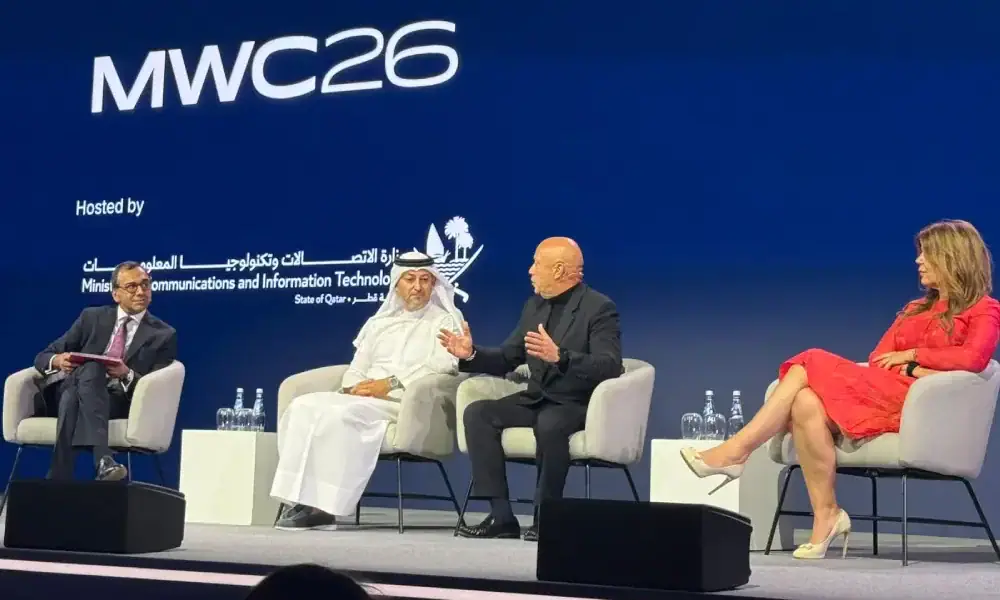
During a panel discussion at the Mobile World Congress (MWC) in Doha, Kaan Terzioglu, CEO of VEON, emphasized that the next phase of growth in the telecommunications sector relies on artificial intelligence (AI) and new network models, rather than cheaper connectivity. He argued that the industry's traditional business model, based on competing on price, is no longer sustainable. Terzioglu was joined by representatives from GSMA, Ooredoo, and Eutelsat in the discussion.
Terzioglu stated that the telecommunications sector has generated low returns for shareholders over the past two decades, with EBITDA margins ranging from 40 to 45%, compared to over 70% for digital platform companies. He noted that the industry's initial value proposition was based on the number of minutes, messages, and gigabytes, but this approach is no longer effective. Instead, Terzioglu believes that the sector should focus on developing AI-powered services that enhance individuals', businesses', and countries' skills, capabilities, and aptitudes.
Terzioglu prefers to use the term "intelligence augmentation" rather than "artificial intelligence" or "superintelligence", as he believes that AI should be designed to enhance human capabilities, not replace them. He cited an example from VEON's operations, where AI-powered internal audit functions have enabled the company to detect anomalies in real-time, rather than conducting annual retrospective exams. This approach has also led to an increase in VEON's internal AI team.
Terzioglu expects AI to create net new jobs in the sector over time, although he did not provide specific details on how this would be achieved. He also highlighted VEON's partnership with Starlink to provide satellite connectivity, which has connected over 13 million subscribers in Ukraine, Kazakhstan, and Bangladesh. This service has been particularly important during network outages caused by conflicts, earthquakes, and floods.
The satellite integration has enabled VEON to provide emergency services, such as sending a single message to confirm that a person is safe, even when terrestrial networks are down. Terzioglu emphasized that this arrangement preserves regulatory and licensing responsibilities, as the satellite capacity is routed through VEON's central networks, which are directly licensed by the government in each market.
Terzioglu also called for the industry to adopt shared infrastructure, citing China and India as examples where multiple major operators share tower companies. He argued that the competitive advantage in telecommunications lies in customer relationships and distribution, rather than ownership of physical infrastructure. By freeing up capital from towers, operators can finance higher-margin digital services and AI.
The shift in focus towards AI and new network models is seen as crucial for the telecommunications sector to drive growth and improve returns for shareholders. As the industry continues to evolve, operators will need to adapt to changing market conditions and customer expectations. With its emphasis on AI and satellite connectivity, VEON is positioning itself at the forefront of this transformation.
Key points
- Telecom operators should focus on developing AI platforms to drive growth.
- The industry's traditional business model, based on competing on price, is no longer sustainable.
- AI is expected to create net new jobs in the sector over time.