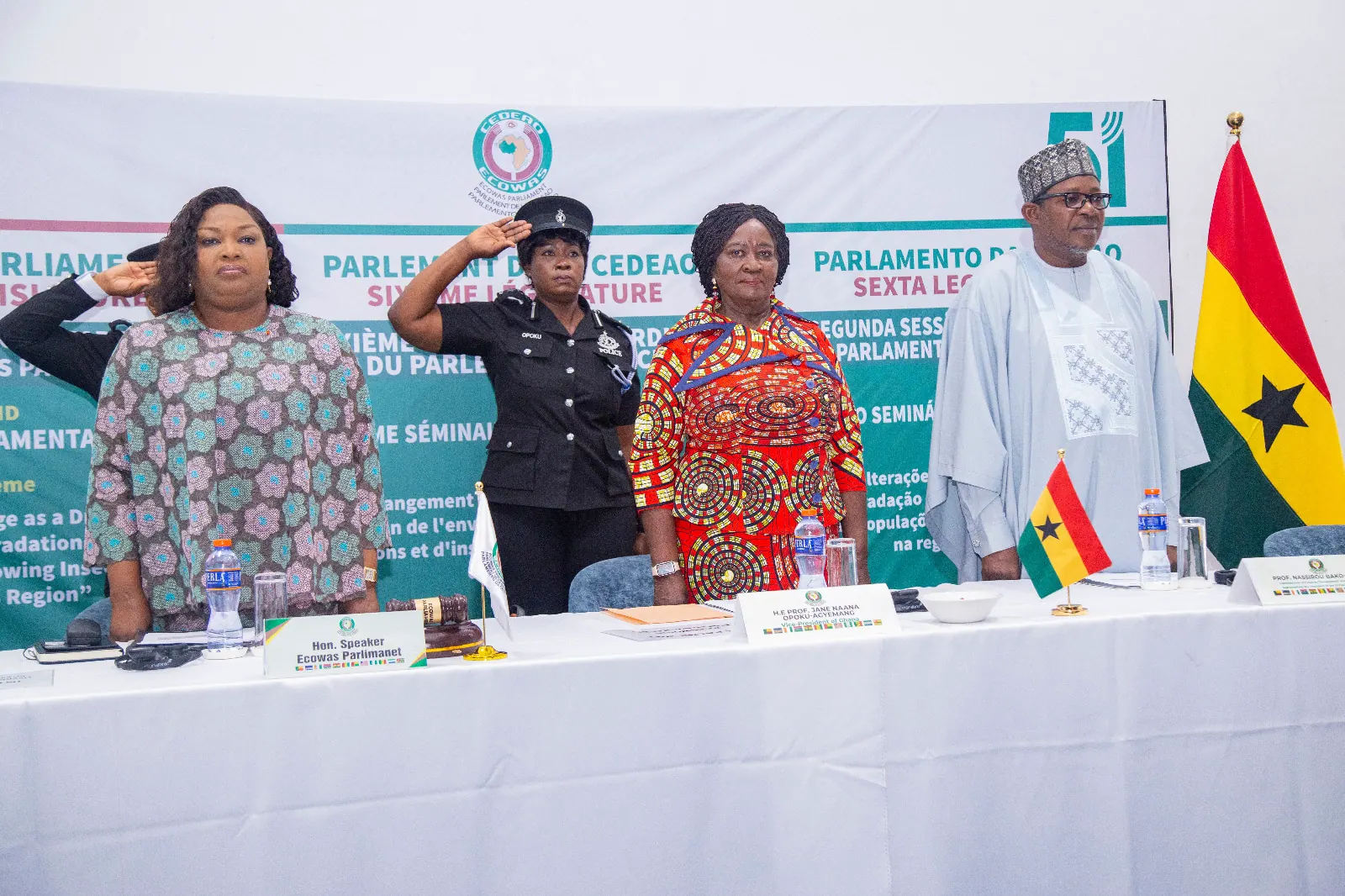
Vice President Professor Jane Naana Opoku-Agyemang has urged ECOWAS Member States to shift from reactive crisis management to proactive investment in climate resilience, youth opportunities, and early warning systems. She warned that poverty and environmental stress are driving displacement and insecurity across West Africa. The Vice President made this call during the keynote address at the opening of the Sixth Legislature, the Second 2026 Parliamentary Seminar on “Climate Change as a Driver of Environmental Degradation, Population Displacement and Rising Insecurity in the ECOWAS Region”, in Accra.
The Vice President noted that West Africa continues to grapple with climate change and environmental degradation with far-reaching consequences for livelihoods and food security, which are compounded by population displacement and growing insecurity. She emphasized that the interconnected nature of these challenges requires unified responses. According to her, the response must combine security, development, and climate resilience. The Vice President also cited Ghana's recent joint border post with Togo as a practical example of improving border procedures, supporting free movement, and facilitating trade.
Professor Opoku-Agyemang stressed that Ghana is taking practical steps to strengthen vulnerable communities, including progress on phase two of coastal protection projects. She warned that when young people face prolonged destitution and limited prospects for education, employment, or a decent living, criminal and extremist groups can exploit their frustrations. The Vice President emphasized that creating opportunities, strengthening communities, and investing in education and skills all amount to investing in peace.
The Vice President called on ECOWAS to fully implement and resource existing frameworks on free movement, disaster risk reduction, and early warning. She added that Ghana is working with ECOWAS to strengthen early warning through better data sharing. Professor Opoku-Agyemang also urged ECOWAS to strengthen its collective voice to secure finance and practical investment in resilient agriculture, water management, coastal protection, and clean energy.
Madam Hadja Mémounatou Ibrahima, Speaker of the ECOWAS Parliament, proposed a five-point agenda to address the challenges facing the region. The agenda includes responsive legislation and oversight on environment and disaster risk, predictable domestic and regional climate financing, early warning and early action linked to communities, inclusive management of land, water, and forests, and placing youth and women at the centre of resilience.
Professor Nassirou Ball-Arifari, the Commissioner for Human Development and Social Affairs, who represented the President of the ECOWAS Commission, described climate change as a threat multiplier. He disclosed that over two million people were displaced in 2024 due to natural disasters linked to climate change, with over 7 million affected in the ECOWAS space.
Other speakers at the event, including Mr Andrew Amoako Asiamah, the Second Deputy Speaker, Parliament of Ghana, and Mr Kwaku George Ricketts-Hagan, the Head of the Ghanaian Delegation to ECOWAS Parliament, reaffirmed Ghana's commitment to regional democratic governance, peace, security, and sustainable development. They also emphasized the need for ECOWAS to strengthen its own capacity to finance climate adaptation and peace and security.
Key points
- Vice President Professor Jane Naana Opoku-Agyemang calls on ECOWAS to invest in youth opportunities and climate resilience.
- ECOWAS Parliament proposes a five-point agenda to address environmental degradation and insecurity.
- Climate change is a threat multiplier, displacing over two million people in 2024.