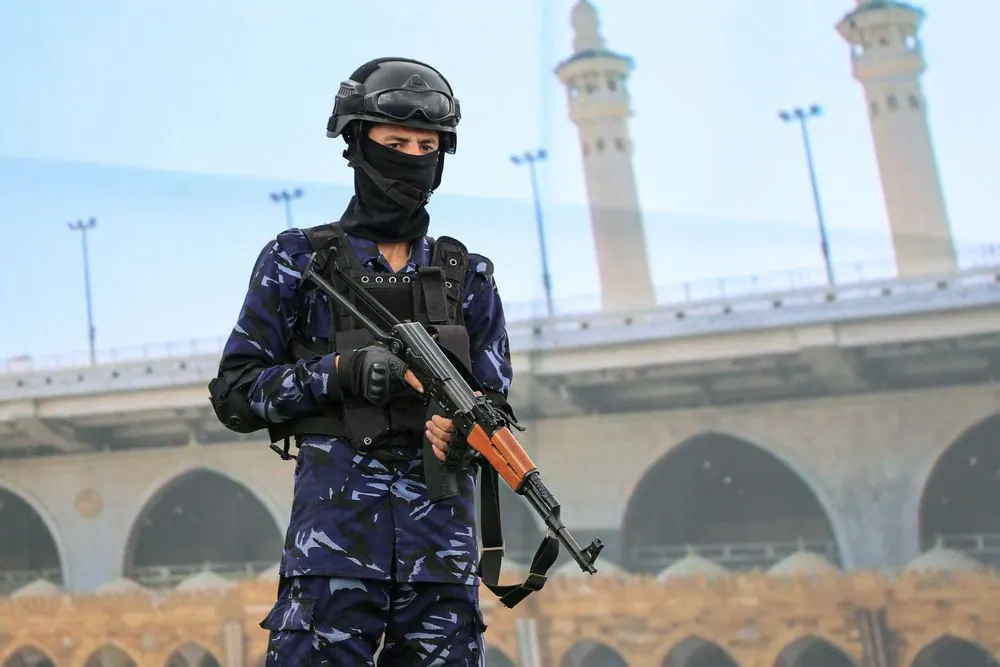
The United States has warned that the conflict between Saudi Arabia and the Iran-backed Houthis in Yemen could escalate rapidly after a missile attack targeted the Saudi capital, Riyadh. The attack, which was claimed by the Houthis, was the first to threaten Riyadh since the Yemen conflict resumed. The US State Department warned that American citizens outside the Middle East should seriously reconsider travel to and through the region.
The missile attack on Riyadh was intercepted and destroyed by the Saudi-led coalition, but it marked a significant escalation in the conflict. The Houthis have been carrying out a lightning offensive in Yemen, seizing swathes of territory and displacing over 110,000 people, according to the UN refugee agency. The violence has disrupted exports from Saudi Arabia, the world's leading supplier of crude oil, as well as maritime traffic.
The US has sent mixed signals on the conflict, with President Donald Trump cutting short a weekend at Camp David to return to the White House, amid reports that he had said the Houthis had agreed not to hit US targets. The US Central Intelligence Agency Director, John Ratcliffe, met Egyptian President Abdel Fattah al-Sisi in Cairo, days after Saudi Crown Prince Mohammed bin Salman was also in the Egyptian capital.
The conflict has also drawn in other countries, with Turkey's Foreign Minister, Hakan Fidan, saying that his country had discussions with Saudi Arabia and Pakistan about possible assistance. The Bab al-Mandab strait, a crucial waterway for energy flows and global shipping, has become a strategic point in the conflict, with Iran imposing a blockade on the Strait of Hormuz.
The Houthis' military spokesman, Yahya Saree, claimed responsibility for the attack, saying that fighters had carried out two successful military operations using ballistic and cruise missiles and drones. The attack targeted sensitive sites in Riyadh and Aramco facilities in Yanbu, an important export hub for Saudi oil.
The conflict has piled further pressure on a global economy already rocked by seven months of war in the Middle East. Iran-backed groups, including Hezbollah in Lebanon and the Houthis in Yemen, have been carrying out attacks against their foes. Iran's top negotiator said that Tehran had conveyed to the US through mediators its conditions for reopening the Strait of Hormuz.
The US has restricted travel for American government employees to the Saudi cities of Taif and Yanbu, home to a major Red Sea oil export terminal that has previously been targeted by Houthi strikes. The US State Department warned that the military conflict has the potential to escalate rapidly, and urged American citizens to exercise caution when traveling to the region.
Key points
- The US has warned of a rapid escalation in the Middle East conflict after a missile attack on Riyadh.
- The Houthis have carried out a lightning offensive in Yemen, displacing over 110,000 people.
- The conflict has disrupted exports from Saudi Arabia and maritime traffic, and has drawn in other countries, including Turkey and Egypt.