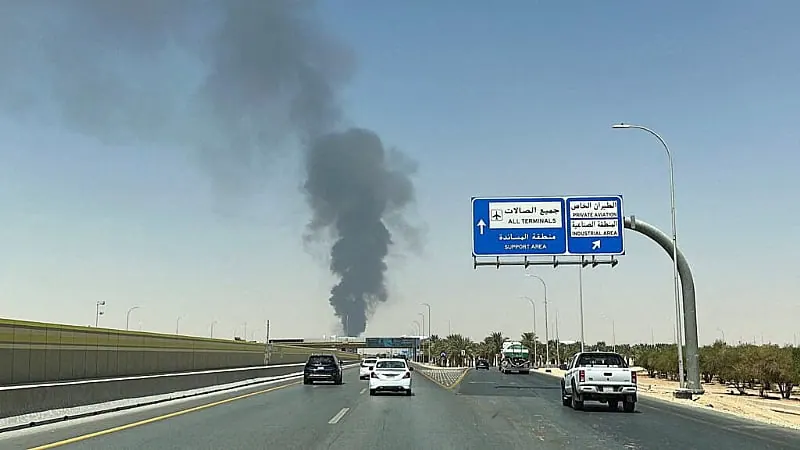
The United States has warned that the conflict between Saudi Arabia and Iran-backed Houthis could escalate rapidly after a missile attack targeted Riyadh, the Saudi capital, on September 19, 2026. A large plume of black smoke was seen rising from the fuel storage area at King Khalid International Airport. The US State Department urged American citizens to reconsider travel to and through the region, citing the potential for rapid escalation.
The Houthis' lightning offensive, which seized swathes of Yemeni territory in recent weeks, has left hundreds dead and displaced over 110,000 people, according to the UN. The conflict has disrupted Saudi Arabia's exports, including crude oil, and maritime traffic. The Riyadh-led coalition confirmed that a ballistic missile launched by the Houthis towards Riyadh was successfully intercepted and destroyed.
The Houthis' military spokesman, Yahya Saree, said in a statement that the group had carried out two successful military operations using ballistic and cruise missiles and drones, targeting sensitive sites in Riyadh and Aramco facilities in Yanbu. The Saudi authorities had issued an overnight air raid alert, and residents reported hearing explosions echoing through parts of the city.
This is the first time since Yemen's civil war resumed that strikes have threatened the Saudi capital, piling further pressure on a global economy already rocked by seven months of war between the US and Iran. The incident comes days after Riyadh accused the Houthis of targeting Mecca, denouncing it as a "cowardly terrorist attack" on Islam's holy city.
The United States, according to US news platform Axios, last week refused a Saudi request to strike the Houthis. However, Washington approved a $24.3 billion sale of 48 F-35 fighter jets to the kingdom on Thursday to help Riyadh "deter current and future threats", the US State Department said.
The war in Yemen broke out in 2014 when the Houthis seized control of the capital Sanaa and other regions, triggering a military intervention led by Saudi Arabia in March 2015. The fragile truce reached in 2022 between the warring parties collapsed in July, when the Houthis defied Riyadh's control of Yemeni airspace by allowing an Iranian aircraft to land in Yemen.
The Houthis have been improving their defences in newly conquered territory along Yemen's Red Sea coastline, with members of the group telling AFP they have been installing radar and digging tunnels. The conflict has already disrupted global oil supplies and maritime traffic, and further escalation could have significant economic and humanitarian implications.
Key points
- The US has warned of rapid escalation in the conflict between Saudi Arabia and Iran-backed Houthis.
- The Houthis' missile attack on Riyadh has disrupted global oil supplies and maritime traffic.
- The US has approved a $24.3 billion sale of F-35 fighter jets to Saudi Arabia to help deter current and future threats.