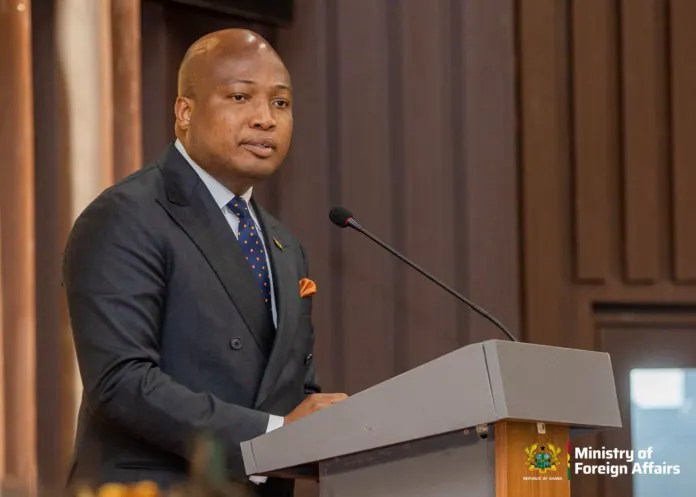
The United States, one of the three countries that voted against Ghana's landmark reparations resolution at the United Nations in March, has quietly signaled its readiness to engage with Ghana on reparatory justice. According to Foreign Affairs Minister Samuel Okudzeto Ablakwa, Washington has formally notified Ghana of its willingness to cooperate on the issue. This development comes months after the US voted against the resolution.
The UN General Assembly adopted Ghana's resolution on reparatory justice in March 2026, recognizing the transatlantic trafficking and enslavement of Africans as a grave crime against humanity. The vote saw 123 countries in favor, 52 abstentions, and just three nations, including the US, voting no. Ablakwa argued that Washington's subsequent outreach shows that the initiative was never meant to be adversarial.
Ablakwa emphasized that the Ghana-led effort is not about dividing the world but rather about bringing nations together, healing, and genuine reconciliation. He stated that President John Dramani Mahama, who chairs the Global Advisory Panel on Reparatory Justice, has no hidden agendas or secret motives. The President has been driving the agenda in his capacity as African Union Champion for Reparations.
The US is not the only Western power warming up to the idea of reparatory justice. Ablakwa disclosed that the United Kingdom, the Netherlands, and Denmark have also reached out to Ghana to engage on the issue, following the UN vote. Additionally, Portugal has signaled similar interest after a bilateral meeting with its Foreign Minister.
The growing acceptance of the initiative was evident at a High-Level Side Event on "Next Steps" hosted by President Mahama in New York, which was co-hosted by Ghana, Germany, and France. Ablakwa pointed to this event as evidence that the initiative is not an effort to divide nations. He acknowledged that the subject remains difficult and emotionally charged for many countries.
Ablakwa highlighted the return of African cultural artifacts held in Western museums and private collections as a tangible early step in the reparations push. He commended France, Germany, and the Netherlands for publicly committing to return items to Ghana and urged other nations to follow suit. This move is seen as a crucial step towards reconciliation.
The significance of Ghana's efforts lies in whether Western governments follow through on artifact returns and policy dialogue that could shape future reconciliation frameworks. While no immediate financial payouts have been announced or promised, ordinary Ghanaians are hopeful that concrete commitments will be made. The timeline for formal talks between the US, UK, Netherlands, Denmark, or Portugal and Ghana remains unspecified.
Key points
- The US has expressed willingness to work with Ghana on reparatory justice despite opposing the UN resolution.
- Other Western countries, including the UK, Netherlands, Denmark, and Portugal, have also shown interest in engaging with Ghana on reparatory justice.
- The return of African cultural artifacts is seen as a crucial step towards reconciliation.