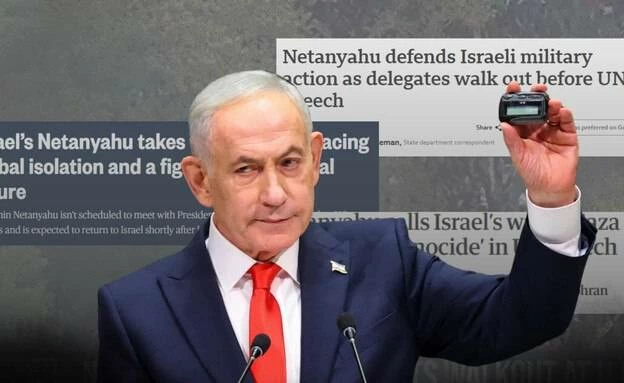
Israeli Prime Minister Benjamin Netanyahu's speech at the UN General Assembly in New York was widely covered by major international media outlets. The speech was seen as an attempt to address both his domestic and international audiences, with many outlets noting that it was largely an electioneering exercise. Netanyahu's appearance was marked by the departure of hundreds of diplomats in protest of Israel's policies.
US media outlets, such as NBC, focused on Netanyahu's isolation on the international stage, with many diplomats walking out during his speech. The network noted that Netanyahu's speech was seen as an attempt to appeal to his domestic audience, particularly with elections looming in Israel. Netanyahu's use of props during the speech, including a device resembling a pager that exploded in Lebanon, was also widely covered.
The New York Times provided extensive coverage of the confrontation between Netanyahu and New York City Mayor Zahran Mammadou. The paper described Netanyahu's speech as aggressive, with the Prime Minister defending Israel's actions in Gaza and Iran. Mammadou responded by accusing Netanyahu of attempting to legitimize the genocide of Palestinians.
The paper also highlighted the vast differences between Netanyahu's speech and that of Palestinian President Mahmoud Abbas, who was forced to deliver his address via video link due to US visa issues. The contrast between the two speeches underscored the deep divisions in the Israeli-Palestinian conflict.
BBC reported that Netanyahu's speech was aimed at two main audiences: Israelis facing a crucial election and Americans, amid growing Israeli isolation. The network noted that Netanyahu's response to the diplomats' walkout seemed rehearsed, with the Prime Minister labeling them cowards.
The BBC also covered the arrest of dozens of protesters outside the UN building, including US actress Susan Sarandon. Meanwhile, The Guardian described Netanyahu's speech as an electioneering exercise aimed at rallying his right-wing base. The paper noted that the speech failed to offer new insights into Israel's policies on Gaza, West Bank settlements, or regional conflicts.
The Guardian also highlighted Netanyahu's brief visit to New York, where he failed to meet with US President Donald Trump, who instead met with Chinese President Xi Jinping. The paper concluded that Netanyahu's speech was largely seen as an attempt to bolster his domestic support, rather than offering a new vision for the Israeli-Palestinian conflict.
Key points
- Netanyahu's speech was seen as an electioneering exercise aimed at rallying his domestic base.
- The speech highlighted Netanyahu's growing isolation on the international stage.
- Media outlets noted that the speech failed to offer new insights into Israel's policies on key issues.