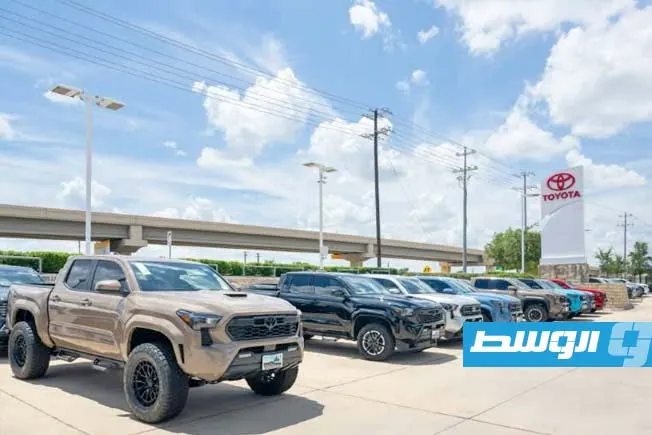
US President Donald Trump's tariffs on imported cars have led some automakers to expand production in the US, reducing their reliance on imports. Companies like General Motors, Toyota, and Ford have announced plans to increase production at their US plants or move production from abroad to take advantage of underutilized capacity. The tariffs, which include a 25% duty on imported vehicles, aim to support the US automotive sector.
Despite these efforts, the benefits of the tariffs have been limited, and investment in the sector is slowing due to trade uncertainty. According to a report by France Press, the tariffs have created a "partial success" for the US automotive industry, but experts warn that the uncertainty surrounding Trump's trade policies is hindering greater gains. The report notes that the US automotive sector has seen a slight increase in employment, but production levels remain stable and are not expected to increase significantly until around 2030.
The uncertainty surrounding US trade policies has affected not only automakers but also suppliers, who provide parts and technology to the industry. According to Tyler Harp, an economist at the Center for Automotive Research, supplier investment has slowed significantly due to uncertainty over tariffs. Data from the center shows that supplier investment fell from over $8 billion in the first quarter of 2025 to around $600 million in the next two quarters before partially recovering.
The US automotive sector has seen a slight increase in employment, with the number of workers in the sector reaching almost 1.8 million in September, according to the US Bureau of Labor Statistics. However, this number is still 2% lower than the peak reached in July 2024. The sector is also expected to see an increase in automation and robotics, with companies investing in new technologies to improve efficiency.
The impact of Trump's tariffs on the US automotive sector has been mixed, with some companies benefiting from increased production and others facing higher costs. According to Stephanie Brinley, an analyst at Mobility Global, the tariffs have led to a "partial success" for the US automotive industry, but the uncertainty surrounding trade policies is hindering greater gains. The report notes that the US automotive sector is expected to produce around 10 million vehicles in 2026, similar to last year's levels.
Suppliers have identified trade policy changes as the biggest threat to the sector over the next 12 months, according to a survey by the Motor Vehicle Suppliers Alliance. Around 80% of companies surveyed ranked trade policy changes as one of the top four threats, along with a weak US economy, external events, and weak car sales. The sector has not been able to fully offset the costs associated with Trump's tariffs, which is putting pressure on suppliers' profit margins.
The US automotive sector is expected to see significant investment in the coming years, with General Motors planning to invest $4 billion in new production capacity in Michigan, Kansas, and Tennessee. Toyota is also investing $3.6 billion to move production of its Tacoma pickup truck from Mexico to Texas. However, the uncertainty surrounding US trade policies remains a major challenge for the sector, and suppliers are calling for greater clarity on trade policies to support investment and growth.
Key points
- US tariffs on imported cars have yielded limited gains for the US automotive sector.
- Trade uncertainty is slowing investment in the sector.
- Suppliers are calling for greater clarity on trade policies to support investment and growth.