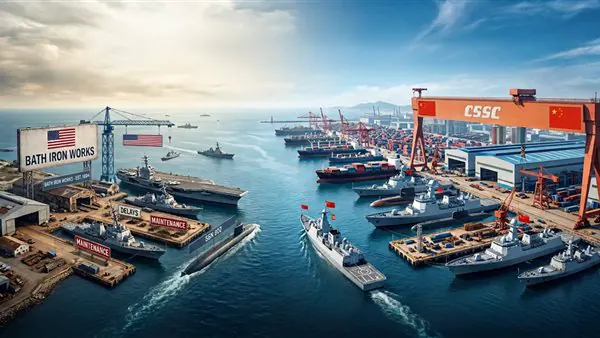
The United States is facing a stark contrast between its ambitions for naval supremacy and the reality of its declining shipbuilding industry. Despite the US Navy's claims of global dominance, the country's share of commercial shipbuilding has dwindled to a mere 0.1%, with China controlling over 50% of the global market. The US has historically relied on government support to maintain its presence in the global shipbuilding market, but this approach is becoming increasingly unsustainable.
The US Navy is facing significant challenges in building and maintaining its fleet, with delays in delivering new ships and a lack of capacity in its shipyards. According to the Government Accountability Office, the US Navy's shipbuilding program has been plagued by delays, with some ships taking up to three years longer than expected to complete. This has resulted in a shortage of ships available for deployment, with the US Navy currently operating with a fleet of around 290 ships, down from over 300 in the early 2000s.
In contrast, China has emerged as a major player in the global shipbuilding industry, with its state-owned shipyards producing a wide range of commercial and military vessels. China's shipbuilding industry has been driven by significant government investment and support, allowing it to undercut US shipyards on cost and quality. As a result, China's navy has grown rapidly, with over 841 ships currently in service, compared to the US Navy's 465 ships.
The US Navy's struggles have been highlighted in a recent report by the National Interest, which noted that the US would need to invest significantly in its shipbuilding industry to remain competitive with China. The report estimated that the US Navy would need to spend around $65.8 billion to upgrade its fleet and maintain its competitive edge. However, this investment is not guaranteed, and the US Navy's shipbuilding program remains uncertain.
One of the key challenges facing the US Navy is the high cost of building ships in the US compared to China. According to a report by Military Watch, the cost of building a commercial ship in the US is around $330 million, compared to just $60 million in China. This has made it difficult for US shipyards to compete with their Chinese counterparts, which have been able to produce high-quality ships at a significantly lower cost.
The implications of the US Navy's struggles are significant, with many experts warning that the country's ability to project power globally could be compromised if it is unable to maintain a strong naval presence. The US Navy plays a critical role in protecting US interests abroad and maintaining the free flow of trade and commerce. If the US is unable to maintain its naval supremacy, it could create opportunities for other countries, including China, to expand their influence.
To address these challenges, the US Navy is exploring new approaches to shipbuilding, including partnerships with private industry and investments in new technologies. However, these efforts are still in their early stages, and it remains to be seen whether they will be enough to reverse the decline of the US shipbuilding industry. Ultimately, the US will need to make significant investments in its shipbuilding industry if it is to maintain its naval supremacy and protect its interests abroad.
Key points
- The US Navy faces significant challenges in maintaining its naval supremacy due to China's rapid expansion in shipbuilding.
- The US shipbuilding industry has declined significantly in recent years, with China now controlling over 50% of the global market.
- The US Navy will need to invest significantly in its shipbuilding industry to remain competitive with China and maintain its global influence.