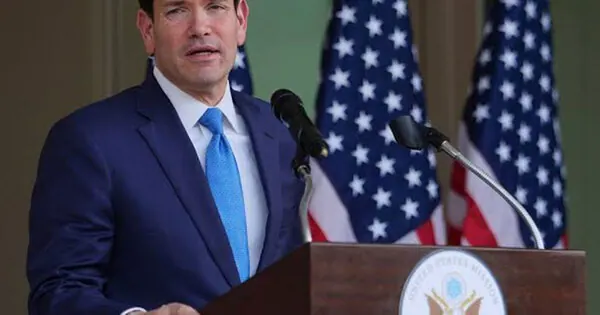
US Secretary of State Marco Rubio stated on Monday that President Donald Trump acted to prevent Iran from reaching a "line of immunity", where Tehran could build up enough missiles, drones, and other weapons to make military action against its nuclear programme far more difficult. Rubio's remarks were made in an interview with Fox News. He said Iran's strategy was to strengthen its conventional arsenal, deter outside intervention, and then move towards a potential nuclear breakout.
Rubio emphasized that Trump's actions saved the world a tremendous amount of trouble. His comments come as a US official revealed that President Trump is willing to give Iran sanctions relief and release frozen funds as part of a final deal, but only if Tehran offers "concrete progress" on the nuclear issue. The US official stated that there would be no deal unless nuclear issues were addressed.
According to the US official, the United States is having "positive and constructive discussions through the mediators". The official noted that Special Envoy Steve Witkoff, Jared Kushner, Vice President JD Vance, and Secretary of State Marco Rubio are leading the talks on the US side. Trump rejected Iran's latest proposal to reopen the Strait of Hormuz, calling it "unacceptable".
On Sunday, Trump told Axios that he expected more talks with Iran to take place that week. The US official said that Iran has indicated flexibility on nuclear issues, but the two sides have not reached an agreement on the timing of commitments. Iranian Foreign Minister Abbas Araghchi stated that Tehran had held further indirect talks with the United States through Qatari mediators in New York.
Araghchi said Iran was awaiting an official response from Washington, expected by Tuesday. He articulated Iran's stance on regional tensions and the critical security situation in the Strait of Hormuz during his visit to the United Nations General Assembly session. Araghchi reiterated that Tehran had put forward a fair and logical plan to resolve the crisis and reopen the vital shipping lane, provided specific conditions were met.
Araghchi added that fresh inputs aimed at narrowing existing differences and facilitating the execution of Tehran's proposals were submitted by Qatari mediators during the latest meeting. The ideas are now being relayed back to Washington. He noted that such communications and messages exchanged by Qatari and Pakistani intermediaries have always existed, but the process has taken on a more serious nature given Iran's proposal.
Last week, Araghchi outlined a seven-day proposal under which Iran would reopen the Strait of Hormuz if certain conditions were met by Washington. The proposal was conveyed through intermediaries and linked the reopening of the waterway to measures including an easing of US military pressure. The US Ambassador to the United Nations, Mike Waltz, rejected the proposal, claiming Tehran sought sanctions relief and access to "billions in frozen assets" before negotiations on its nuclear programme.
Key points
- US Secretary of State Marco Rubio stated that President Trump prevented Iran from reaching a "line of immunity".
- President Trump is willing to give Iran sanctions relief and release frozen funds as part of a final deal, but only if Tehran offers "concrete progress" on the nuclear issue.
- Iran and the US are engaged in indirect talks through Qatari mediators, with Iran awaiting an official response from Washington.