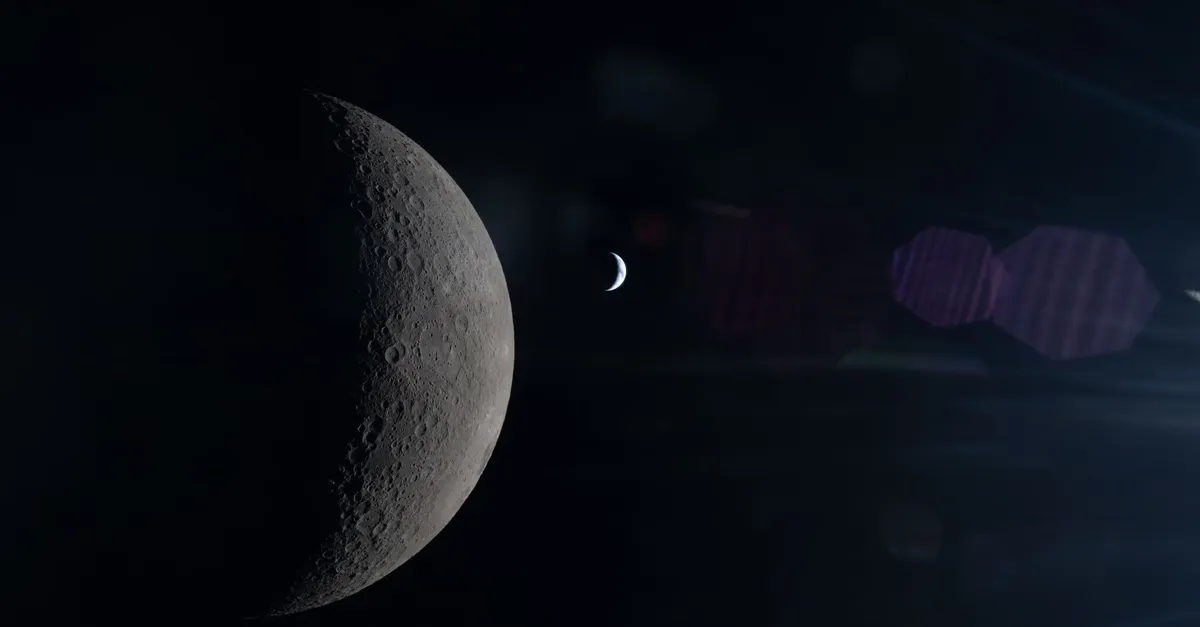
A growing competition between the US, Russia, and China is underway to deploy nuclear reactors on the lunar surface. This endeavor is linked to aspirations of establishing permanent bases and exploiting the moon's resources. However, experts warn of potential risks associated with transporting nuclear materials to space. The US space agency, NASA, aims to develop a reactor capable of withstanding the journey to the moon and operating independently near its south pole, with a target launch date of December 2030.
The US has accelerated its timeline in response to Russia's plans to launch a lunar reactor by 2036, in partnership with China. The three major powers consider nuclear energy essential for establishing sustainable lunar bases, as reactors can operate without relying on sunlight and can be designed to be compact and require minimal human intervention. The US and China initially plan to rely on solar energy and radioisotope-based power generation for heating equipment and charging rovers.
Russia is working on a reactor called "Selena," which can generate up to 10 kilowatts of electricity and operate autonomously for 10 years. In contrast, NASA targets a reactor with a capacity of 20 kilowatts that can function for five years without human intervention. The lunar night lasts over two weeks, and temperatures near the south pole range from -130°F to 334°F, making nuclear reactors a crucial component for future lunar bases.
Scientists warn that the rush to achieve these goals may overlook safety considerations, as launching a nuclear reactor into space is a high-risk operation. Edwin Lyman, director of nuclear energy safety at the Union of Concerned Scientists, notes that introducing nuclear energy into space exploration may increase the danger of competition. Although the US and Russia plan to keep reactors non-operational before reaching the moon, accidents during launch or re-entry remain possible.
The US faces challenges related to fuel, as NASA plans to use high-assay low-enriched uranium (HALEU), considered safer than highly enriched uranium but with limited supplies. In contrast, Russia's partnership with China has not disclosed the type of fuel they will use for their lunar reactor. Technical questions remain regarding reactor cooling, radiation protection, and waste management.
Experts argue that increasing a lunar reactor's capacity will make its design more complex, as no country has yet tested such a reactor on the lunar surface. Some advocate for international cooperation in space exploration, citing past successes, and suggest that a collaborative approach could be more beneficial than competition.
As the US, Russia, and China continue their pursuit of lunar nuclear reactors, the world watches with interest, aware that this competition may set the stage for future space exploration and the utilization of lunar resources.
Key points
- The US, Russia, and China are racing to deploy nuclear reactors on the moon to support permanent lunar bases.
- The reactors are designed to operate independently, with Russia's "Selena" reactor aiming for 10 years of autonomous operation.
- Safety concerns and technical challenges surround the development and deployment of lunar nuclear reactors.