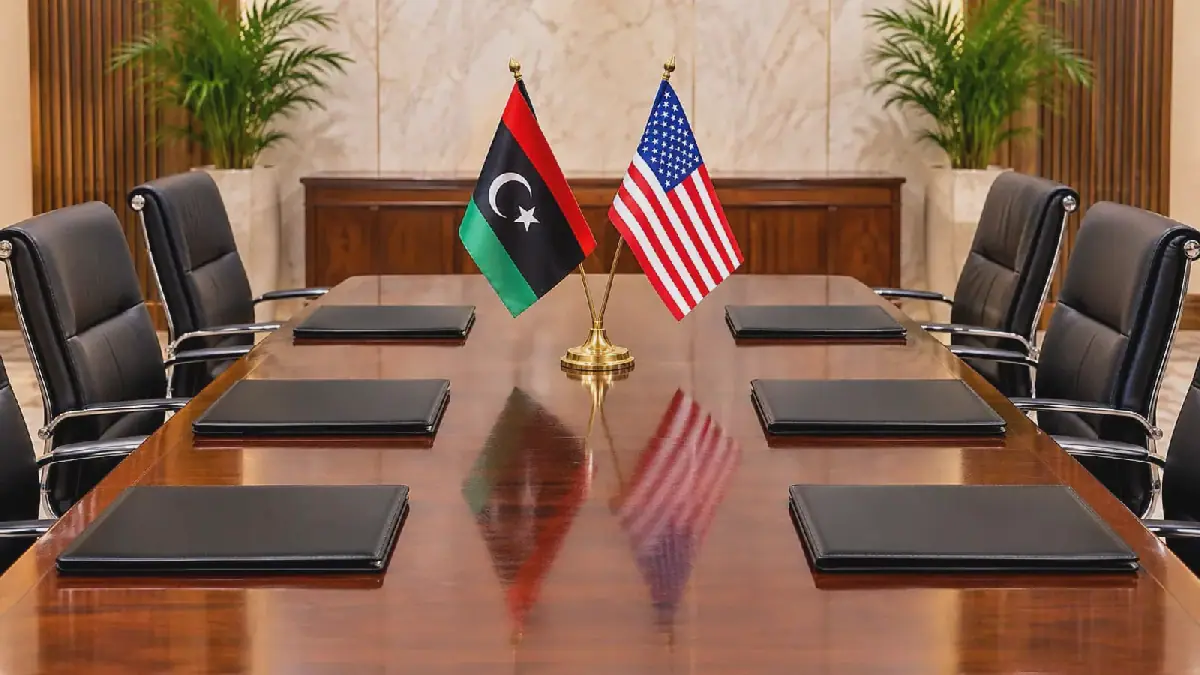
The United States is working to bring Libya's rival factions together under a single executive authority, with a comprehensive framework for unifying institutions reportedly agreed upon. However, the success of the US effort will not be measured solely by bringing competitors together in one government, but by ensuring that those in power are committed to elections that could potentially remove them from office.
US President Joe Biden's senior adviser for Arab and African affairs, Mesad Bols, stated that the parties have reached a "clear and comprehensive" framework that enjoys broad local and international support. He emphasized that the time for implementation is now, warning of consequences for those who obstruct the process. This comes as economic discussions are underway in Washington and political talks are taking place in Istanbul.
The goal of the US initiative is to establish a unified executive authority capable of governing the entire country, providing greater economic security and stability, and paving the way for national elections. Bols' comments did not confirm or deny reports of a specific formula for power-sharing, which would see Abd al-Hamid al-Dabaiba remain as prime minister and Sadam Hifter take over as head of the presidential council.
Libyan MP Essam al-Jahani said that the US initiative aligns with the House of Representatives' efforts to unify the government and sovereign positions. He linked progress to consensus on the "4+4" track, describing the process as a Libyan-led search for a solution. However, he limited his comments to general principles, without confirming specific details.
Some analysts, however, are skeptical about the prospects for success. Karem Mezran, director of the North Africa Initiative and senior resident fellow at the Atlantic Council, believes that the main obstacle lies in the calculations of the parties themselves. He thinks that Sadam Hifter will face rejection in Tripoli, Misrata, and other western Libyan cities.
Experts recommend that any unified government should have a limited mandate and a clear timeline for completing legislation and holding elections. They also stress the importance of protecting the independence of the High National Election Commission, adopting merit-based appointments, and establishing independent oversight with UN facilitation and significant civil society participation.
The international community's support for a unified Libya is driven by a shared interest in stability and security in the region, particularly in the Mediterranean. However, experts caution that the effectiveness of external support will depend on the cohesion of the Western position and its ability to limit external backing for spoilers.
Key points
- The US is pushing for unified Libyan government ahead of elections.
- Elections seen as key step towards ending country's divisions.
- Success of US effort hinges on commitment to elections that could remove those in power from office.