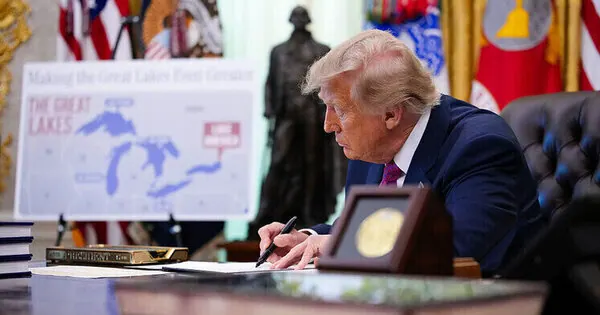
US President Donald Trump has signed into law a sweeping expansion of sanctions against Russia. The new law gives Washington new powers to target Moscow and major buyers of Russian energy. The legislation authorizes tariffs of up to 100% on goods from certain countries purchasing Russian oil and gas. Imports from Russia could face duties of up to 500%. The law aims to increase economic pressure on Moscow over the Ukraine conflict.
The Lindsey O. Graham Sanctioning Russia and Iran Act originated with Republican Senator Lindsey Graham and Democratic Senator Richard Blumenthal. The Senate approved the legislation 86-11 in August, and the House passed it 262-159. The law broadens restrictions covering Russian government-linked officials, financial institutions, and enterprises. It also targets vessels used to circumvent restrictions on Russian oil exports.
The law gives the president authority to impose tariffs of up to 100% on goods from countries among the five largest buyers of Russian crude oil or natural gas. China and India are among the countries most exposed to the secondary tariff provisions due to their large purchases of Russian crude. Türkiye, a NATO member, is also a major importer of Russian energy.
China and India have rejected US pressure over their energy trade with Russia. Their economic and energy interests will guide their policies. China's Commerce Ministry has said Beijing reserves the right to take "all necessary measures" to protect its sovereignty and development interests. India's Foreign Ministry has reiterated New Delhi's commitment to ensuring energy security for its 1.4 billion people.
The legislation retains a 500% tariff on goods imported directly from Russia into the US. However, it contains exemptions and gives the president considerable waiver authority. The White House highlighted that discretion while backing the bill. The president can lift sanctions following a peace agreement.
Moscow has criticized the legislation, with Kremlin spokesman Dmitry Peskov saying the new restrictions would not achieve their stated objectives. The Russian Embassy in Washington has argued that the measures could have consequences for the US economy, particularly amid tight global energy supplies.
The law's impact will depend heavily on how the administration implements it. The US-Russia trade relationship may not grind to a halt due to exemptions and waiver authority. The legislation aims to increase economic pressure on Moscow over the Ukraine conflict while giving the president broad discretion over waivers and termination of sanctions.
Key points
- The law authorizes tariffs of up to 100% on goods from countries purchasing Russian oil and gas.
- China and India are among the countries most exposed to the secondary tariff provisions.
- The law's impact will depend heavily on how the administration implements it.