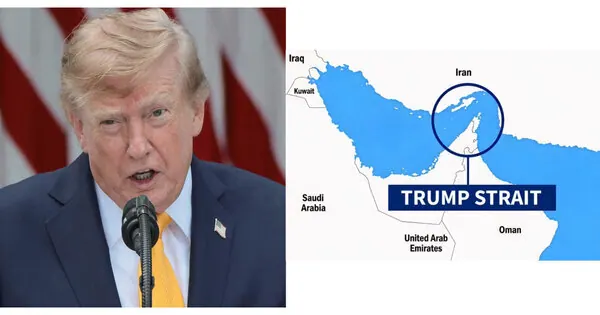
US President Donald Trump has shared a map on Truth Social showing the Strait of Hormuz labelled as "Trump Strait". This action follows his rejection of an Iranian seven-day framework proposal aimed at reopening the crucial waterway and restarting nuclear negotiations. The Strait of Hormuz remains a primary strategic leverage point for Iran in its ongoing standoff with Washington.
According to The Washington Post, Trump maintained that Iran would never acquire a nuclear bomb, voiced doubt that Tehran would comply with his terms, and warned that a renewed US bombing campaign remained a strong possibility. Iranian Foreign Minister Abbas Araghchi stated that normal maritime passage through the Strait of Hormuz could be restored within seven days if Washington agreed to Tehran's conditions.
The proposed terms required the US to lift its naval blockade of Iranian ports, waive sanctions on Iranian oil exports, and respect a ceasefire encompassing Lebanon. Araghchi said, "If the necessary conditions are met, the strait can be reopened, and normal maritime passage restored within seven days. The choice now rests with the United States."
This development follows earlier statements from Trump regarding potential US control over the Strait of Hormuz. Back in August, he published a map indicating the waterway might become "new US territory". Trump previously characterised the notion of designating Hormuz as a US territory as a "great idea", asserting that Washington effectively managed the strait through its ongoing blockade.
While acknowledging that Tehran retained the capability to disrupt maritime traffic by deploying mines, he maintained that the US blockade had proven successful. Prior to the war, approximately one-fifth of globally traded oil and gas transited through the strategic waterway, as outlined by The Washington Post.
Ongoing shipping disruptions have impacted global energy markets and elevated political pressure on the Trump administration ahead of the US midterm elections. Iran's latest proposal directly conditioned the reopening of the shipping lane on the removal of the US naval blockade, comprehensive sanctions relief, and the re-establishment of diplomatic engagement concerning its nuclear programme.
The situation remains tense as the US and Iran have not shown signs of backing down. The international community watches closely, concerned about the potential consequences of an escalation in the region.
Key points
- US President Donald Trump shares a map labelling the Strait of Hormuz as "Trump Strait".
- Iran's Foreign Minister Abbas Araghchi proposed a 7-day ceasefire offer to reopen the Strait of Hormuz.
- The Strait of Hormuz is a primary strategic leverage point for Iran in its ongoing standoff with Washington.