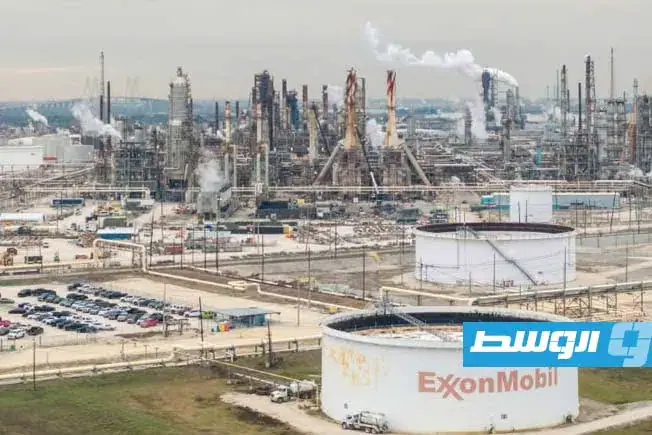
US oil companies are working to increase fuel production from their refineries as supply shortages, driven by conflicts in Russia and Iran, continue to impact the global market. ExxonMobil's CEO, Darren Woods, stated that the company has achieved "record levels of unit operation" outside the Middle East, with its Gulf Coast refineries running at full capacity. This comes as gasoline prices in the US remain above $4 per gallon, a sensitive level politically, while diesel prices approach record highs of over $6 per gallon.
Analysts have identified several factors contributing to the shortage of diesel and other essential refined products. In addition to production losses in the Middle East and Russia due to Ukrainian drone strikes, Woods cited a decline in Chinese production of oil derivatives. He believes it will take until after next year for the situation to return to normal, but it may take longer. This situation has led to increased investment in refinery capacity, with ExxonMobil spending around $17 billion on refining projects, including expansions in Beaumont, Texas, and Baytown, Texas.
Chevron, a rival US oil company, has also reported record crude oil processing volumes in its refineries during the third quarter. CEO Mike Wirth stated that the company is reinvesting to increase energy supplies in a market experiencing shortages. However, around 10% of the world's refining capacity remains offline, according to Chevron's vice chairman, Mark Nelson. Nelson expects refining profit margins to eventually decline as refinery activity recovers and export flows increase, but this may take some time.
The global refining landscape has been impacted by several factors, including Ukrainian drone strikes on Russian facilities, which accounted for 6.5% of global refining capacity in 2025. According to KPMG, these strikes have significantly affected Russian refining capacity. The International Energy Agency (IEA) reported in September that only five Russian refineries remained unaffected by Ukrainian drone strikes since the 2022 Russian invasion. As a result, Russian production has declined to 3.8 million barrels per day, its lowest level in 20 years.
The ongoing supply shortages and price increases have led to protests in various regions, including Asia, Latin America, and Europe. In response, US oil companies are taking steps to increase production capacity. ExxonMobil and Chevron reported significant increases in quarterly profits, driven by higher commodity prices and refining margins. However, the sharp price increases and supply shortages have become a political burden for US President Joe Biden's administration, which has pressured oil companies to take steps to mitigate the impact on consumers.
The Russian refining sector has been severely impacted by Ukrainian drone strikes, with several major facilities affected. According to Russian Deputy Prime Minister Alexander Novak, Ukraine has resumed its attacks on Russian facilities, targeting three oil refineries and a chemical and gas complex. This has led to concerns about potential shortages and price increases in the global market.
As the global market continues to navigate supply shortages and price increases, US oil companies are working to increase production and alleviate pressure on consumers. ExxonMobil and Chevron have reported significant investments in refining capacity, and the companies expect production to increase in the coming months. However, it remains to be seen how long it will take for the global market to return to normal and for prices to stabilize.
Key points
- US oil companies are investing in increasing fuel production from their refineries to address global supply shortages.
- The ongoing supply shortages and price increases have led to protests in various regions, including Asia, Latin America, and Europe.
- ExxonMobil and Chevron reported significant increases in quarterly profits, driven by higher commodity prices and refining margins.