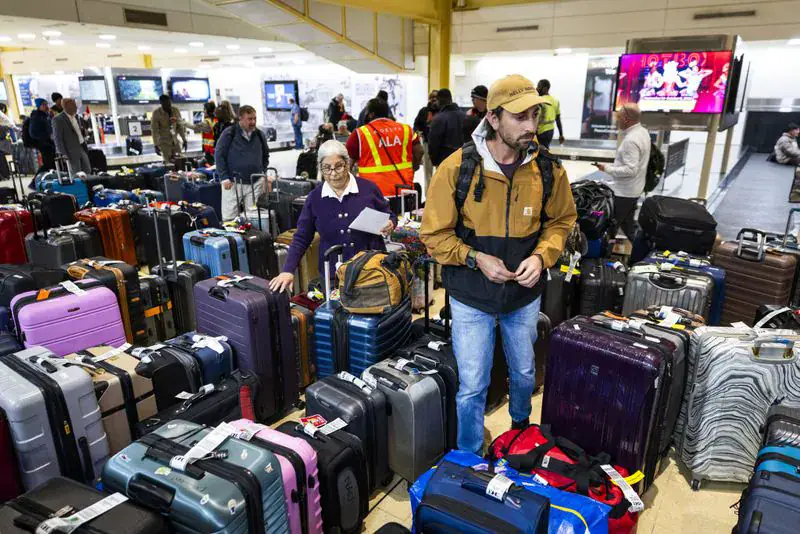
The US Federal Aviation Administration lifted a nationwide ground stop on Friday, allowing flights to resume after a communications failure at air traffic control centers caused widespread disruptions. The failure, which occurred at 3:36 p.m. Eastern Time, resulted in over 6,600 flight cancellations and 8,600 delays, with another 1,500 cancellations already scheduled for Sunday. According to FlightRadar24, the disruptions were significant, with tens of thousands of passengers stranded at airports across the country.
Transportation Secretary Sean Duffy attributed the failure to an aging air traffic control system, citing overloaded switches and routers that led to inconsistencies in data. He emphasized that flying was safe, but warned that a broader overhaul of the system was necessary to prevent similar failures. Duffy also called for $50 billion to modernize the air traffic control system, blaming Congress for failing to fund a new system that could prevent such outages.
The nationwide ground stop was only the third in US history, following the September 11, 2001, terrorist attacks and a 2023 FAA system outage. Aviation analysts warned that the four-hour grounding could disrupt airline schedules for days. Duffy met with President Donald Trump and Homeland Security Secretary Markwayne Mullin to discuss the outage, which appeared to affect a telecommunications network overseen by L3Harris Technologies.
The disruption for passengers was far from over, with thousands facing overnight stays at airports. Edward Kargbo, a 50-year-old passenger, was scheduled to take an Ethiopian Airlines flight to Lomé, Togo, but planned to spend the night at the airport before a rescheduled flight on Saturday. Louise Maher, 47, was also caught up in the disruption at Newark after her British Airways flight to London was canceled.
US airlines will not be required to provide compensation to stranded passengers, as the carriers were not responsible for the FAA system failures. Investors were already pricing in a financial hit to airlines, with shares of American Airlines, United Airlines, and Delta Air Lines falling between 1% and 2% in after-hours trading. American Airlines prioritized flights to smaller cities and international destinations to position aircraft and crews for a faster recovery.
Homeland Security Secretary Markwayne Mullin stated that there was "zero evidence" of a cyberattack or rogue AI system, though investigators had not ruled out either possibility. The National Security Agency was working with the Department of Homeland Security on the investigation. The outage highlighted the strain on a US air traffic control system beset by aging technology, equipment, and communications problems, as well as a shortage of several thousand controllers.
The White House and Department of Transportation had urged Congress to approve $30.1 billion to upgrade the nation's aging airports and air traffic control infrastructure. Duffy emphasized that modernizing the air traffic control system was crucial to preventing similar failures in the future. The incident underscored the need for a more robust and resilient air traffic control system to ensure the safety and efficiency of US air travel.
Key points
- The US air traffic control system is in need of a $50 billion overhaul to prevent similar failures in the future.
Reporting sources
- US to resume flights after air traffic network failure sparks chaos · Daily Maverick