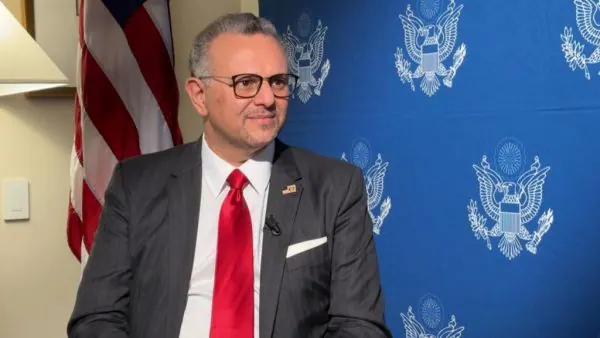
US adviser Massad Boulos has praised Algeria's role in the Western Sahara conflict, saying it is working as a facilitator to find a solution. In an interview with France 24, Boulos acknowledged Algeria's efforts but noted that it cannot impose a solution on the Polisario Front. The conflict dates back to November 1975 when Morocco invaded the Sahrawi territory. Boulos' comments contradict Morocco's claims that Algeria is hindering the negotiation process.
Boulos stated that there is no imminent solution to the conflict, despite three rounds of negotiations between Morocco and the Polisario Front this year. The talks, held in Madrid and Washington, were attended by Algeria and Mauritania as observer countries. While describing the negotiation cycles as "constructive and fruitful," Boulos acknowledged that they did not lead to an agreement on a solution. The US envoy emphasized that the process is ongoing, with the US waiting for the Polisario Front's response to Morocco's autonomy plan.
The autonomy plan, proposed by Morocco, is a key point of contention in the conflict. Boulos indicated that the US continues to engage with the Polisario Front, adding that there is still much work to be done. He expressed confidence in finding a solution but noted that there are no tangible indications of progress at the moment. The conflict has been ongoing for decades, with the Sahrawi people seeking self-determination and independence.
The UN Security Council is set to discuss the Western Sahara conflict at a crucial meeting next month. The agenda includes evaluating the implementation of Resolution 2797, adopted last year, and the possible extension of the mandate of the UN Mission for the Referendum in Western Sahara (MINURSO). The resolution was welcomed by Morocco, which sees it as supporting its autonomy plan.
The Sahrawi government has condemned Morocco's recent statements at the UN General Assembly, accusing Rabat of attempting to distort facts and misrepresent the legal and political status of the Western Sahara question. According to the Sahrawi Arab Democratic Republic (SADR), the UN Security Council has not recognized Moroccan sovereignty over Western Sahara and has not endorsed Morocco's autonomy proposal as the sole solution.
The SADR government reaffirmed the Sahrawi people's right to self-determination and independence, which it considers a "firm and inalienable" right. The government emphasized that the Western Sahara question remains on the UN General Assembly's agenda as a decolonization issue. The Sahrawi people continue to seek freedom, independence, and the restoration of their sovereignty over the entire territory of the SADR.
The international community remains engaged in efforts to resolve the Western Sahara conflict. The US, in particular, continues to play a role in promoting dialogue between the parties. While progress is slow, the involvement of countries like Algeria and the US offers hope for a peaceful resolution to the longstanding conflict.
Key points
- Algeria plays a crucial role in facilitating negotiations on the Western Sahara conflict.
- There is currently no imminent solution to the Western Sahara conflict.
- The UN Security Council is set to discuss the Western Sahara conflict at a crucial meeting next month.