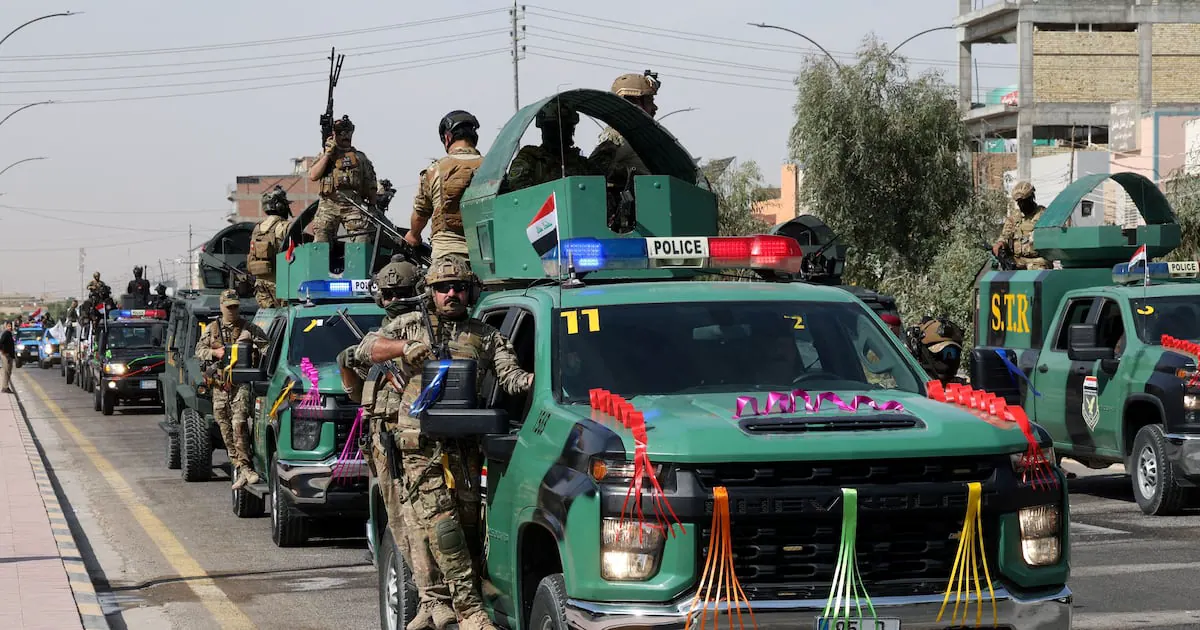
The United States has officially concluded its military mission in Iraq, marking the end of a 23-year presence in the country. The withdrawal of the final US troops, primarily from an airbase in Erbil, was celebrated as a victory by Tehran and its allies. However, many Iraqis expressed concerns that their own security forces may not be adequately prepared to handle the potential security threats. The pullout was agreed upon in 2024 under President Joe Biden and carried out by the administration of former President Donald Trump.
The US-led invasion of Iraq in 2001 led to the toppling of Saddam Hussein's regime, triggering years of upheaval and chaos. US troops initially left Iraq at the end of 2011 but returned less than three years later to combat Islamic State fighters who had seized a third of the country. The US military campaign in Iraq resulted in the deaths of over 4,500 US troops, which is roughly twice the number of US fatalities in the parallel war in Afghanistan. According to the Iraq Body Count project, more than 200,000 Iraqi civilians were killed during the conflict.
The Pentagon announced that the US and its coalition partners had formally concluded "Operation Inherent Resolve," a military campaign aimed at defeating Islamic State. The US will continue to provide targeted training and intelligence support to Iraqi partners. Iraqi Prime Minister Ali Faleh al-Zaidi stated that the end of the international coalition's mission marked Iraq's transition to a phase where it assumes full responsibility for its security and stability. He emphasized that this transition does not signify the end of the battle against terrorism.
The withdrawal of US forces has raised concerns about the potential for Iranian-backed militias to expand their influence in Iraq. Tehran has steadily entrenched itself through proxies in Iraq since the fall of Saddam Hussein. Some Iraqis worry that their security forces, trained and funded by the US, are still not equipped to protect the country effectively. Jassim al-Bahadli, an Iraqi analyst, noted that security vacuums can be extremely dangerous and that the past two decades have shown that such vacuums can have severe consequences.
Many Iraqis are cautious about celebrating the US withdrawal, fearing that it may lead to a new period of instability. Adil Salman, a 45-year-old high school English teacher, expressed concerns that militias still operate outside the state's control and that Islamic State has not disappeared. He emphasized that the decision's success will ultimately be judged by one factor: whether security remains stable in the coming years. The US departure has also raised concerns about the potential for Islamic State fighters to regroup and exploit the security vacuum.
The US pullout from Iraq is being seen as a triumph for Iran's "axis of resistance," a network of allied armed groups across the region. Iran's proxies in Iraq may feel empowered by the absence of a Western military presence, potentially attempting to expand their role in shaping state policies and consolidating their presence within key institutions. Baghdad-based political analyst Ahmed Younis noted that the withdrawal raises the possibility of increased Iranian influence in Iraq.
The US withdrawal has also sparked concerns about the potential for Islamic State fighters to regain momentum. Despite the defeat of their self-proclaimed caliphate nearly a decade ago, Islamic State retains a sleeper cell network. Iraqi security officials, both in the federal government and the semi-autonomous Kurdish region, warn that the US pullout could give new life to Islamic State fighters. Retired Iraqi army General Mohammed al-Jubouri emphasized that the most important question now is whether Iraq's security institutions have prepared a viable plan for the post-coalition phase.
Key points
- The US military mission in Iraq has ended after 23 years, raising concerns about a security vacuum.
- The withdrawal has sparked fears that Iranian-backed militias and Islamic State fighters may exploit the security vacuum.
- The US will continue to provide targeted training and intelligence support to Iraqi partners.