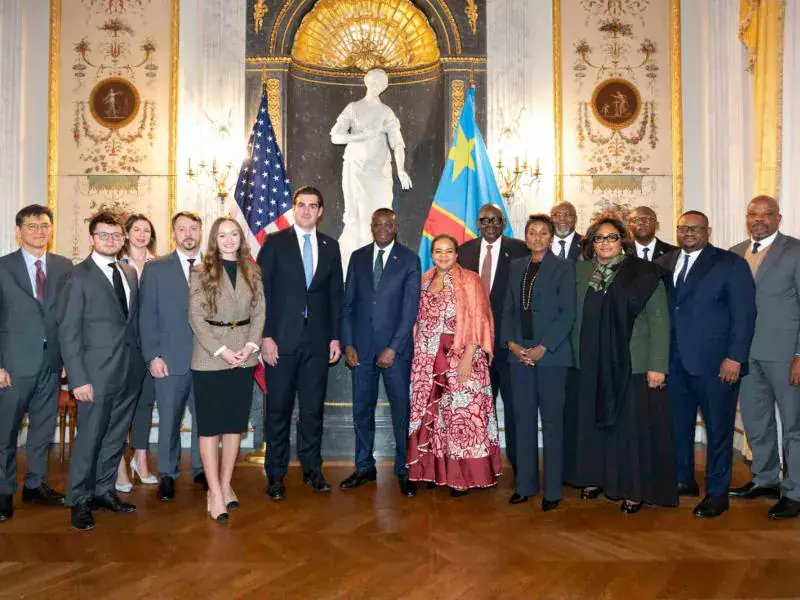
The US and DRC have agreed to move beyond diplomatic engagements to concrete economic projects, as concluded during the second meeting of the Joint Steering Committee (JSC) held on November 5, 2026, in Paris, France. The two governments have reaffirmed their commitment to accelerating the implementation of the Strategic Partnership Agreement (SPA) signed on December 4, 2025. The partnership is based on peace and security, economic growth, responsible investments, infrastructure development, and shared prosperity.
The mining sector is a key area of focus in the discussions, with Washington and Kinshasa expressing mutual interest in developing secure and transparent supply chains for critical minerals. The two governments aim to go beyond the economic model based on extraction and export of raw materials, promoting local transformation, refining, advanced manufacturing, technology transfer, and development of professional skills in the DRC. The goal is to make Congo's mineral resources a lever for industrialization, job creation, and added value for the national economy.
The US and DRC have discussed mobilizing eligible American companies, financial institutions, and private partners to invest in strategic projects in the DRC. They emphasized the importance of transparency, good governance, environmental protection, and social responsibility, while highlighting the need for effective participation of Congolese companies and workers. The Strategic Asset Reserve (SAR) mechanism, provided for in the SPA, was also examined, with discussions focusing on procedures for identifying and designating eligible assets and modalities for mobilizing qualified American investors.
Infrastructure development is another critical pillar of the partnership, with the two governments highlighting the Grand Inga project, whose inaugural coordination and governance committee meeting was held on October 26, 2026. They exchanged views on the project's progress, technical, financial, institutional, legal, and regulatory work necessary for its preparation. Mobilizing public and private financing, particularly from development financing institutions and multilateral banks, was also raised as a concern.
The US and DRC have also discussed the Sakania-Lobito corridor, considered a key axis for strengthening trade and investment in the region. The two governments have identified priority actions for infrastructure and investments related to this corridor as areas requiring special follow-up. Peace and security in eastern DRC and the Great Lakes region were also emphasized as essential conditions for realizing the ambitions of their partnership.
The two governments have identified several operational priorities to maintain momentum, including finalizing the SAR framework, structuring the process for selecting priority projects, and pursuing preparatory work on Grand Inga. They also plan to engage in targeted exchanges with American investors, development financing institutions, and other private sector partners.
The US and DRC aim to make the SPA an instrument for economic development, stability, and shared prosperity, reaffirming their commitment to evolving their relations towards more result-oriented cooperation.
Key points
- The US and DRC have agreed to accelerate their strategic partnership, focusing on critical minerals, infrastructure development, and economic growth.
- The partnership aims to promote local transformation, refining, and advanced manufacturing of critical minerals in the DRC.
- The two governments have identified priority actions for infrastructure and investments related to the Sakania-Lobito corridor.