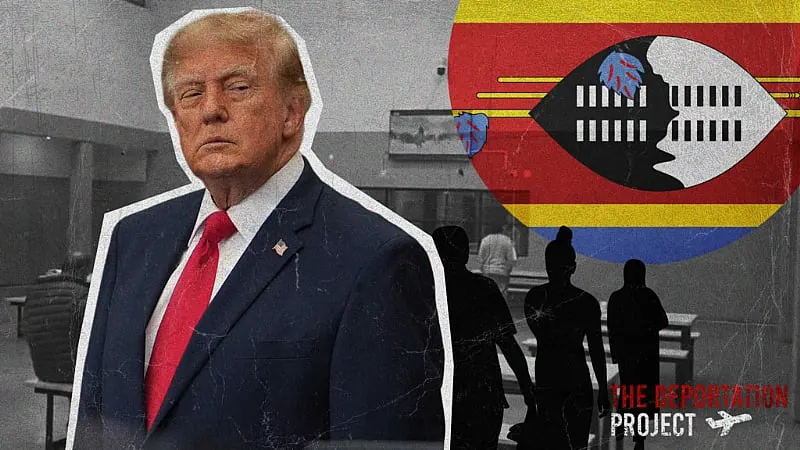
In a small southern African kingdom, protests are rare and largely repressed, but over a hundred women gathered in front of the US embassy in Manzini on July 18, 2025, to demand the return of foreign "criminals" who had been transferred to Swazi prisons. The women were concerned about the safety of their children and shouted slogans, including "Come out, ambassador! Come out and talk with us!" The protest was a reaction to the secret arrival of deportees from the US, who had been convicted by the US justice system and were being held in Eswatini prisons under a secret agreement negotiated by the Trump administration.
The secret arrangement between the US and Eswatini has sparked an outcry, with many questioning the decision to host 160 deportees in total. The deportees, who come from countries such as Vietnam, Laos, Yemen, Cuba, Ethiopia, the Democratic Republic of Congo, and Jamaica, are being held in the central prison of Matsapha, not far from Manzini. According to Sibusiso Nhlabatsi, a lawyer and human rights specialist, the deportees were "transported like a bag of potatoes" and were being held in prison despite never having committed a crime in Eswatini. Nhlabatsi has been fighting to meet the deportees and has taken his case to the Supreme Court, which ruled in his favor in 2025.
Nhlabatsi has since traveled every week to the brand-new wing of the high-security prison in Matsapha to meet with the deportees. He has found that the deportees' cases are complex, but they all have one thing in common: they were previously convicted by US courts. However, Nhlabatsi stressed that they were not the monsters they were being made out to be, and most of them had been rehabilitated and had rehabilitation certificates. The lawyer said that it was not like they were taken straight from jail in the US and then deported, but rather they had been living in American society.
One of the deportees, Dung Nguyen, a Vietnamese man who was convicted of rape in 2011 and released in 2015, shared his story with FRANCE 24 and Forbidden Stories. Nguyen said that he had never heard of Eswatini and was asked to sign papers, which he refused to do. He was told that whether he signed or not, he would still be left in Eswatini. Nguyen had married, bought a house, and found work in the US before being arrested and deported. Despite his detention, he said that he was not subject to the same strictures as Swazi inmates and had access to social media and could leave the prison to go to the nearest shopping mall.
The US-Eswatini agreement has been criticized by opposition activists, who describe it as "an evil deal." Siboniso Mkhabela, the national organizing secretary of the opposition People's United Democratic Movement (PUDEMO), said that the relationship between the US and Eswatini had taken a turn since Trump came to power. Mkhabela pointed out that the deal was negotiated during a period when the Trump administration was dismantling its USAID program, on which Eswatini heavily relied. The opposition activist said that the government may have had little choice but to make a deal, but it was a bad one.
The Coca-Cola factory, a wholly owned subsidiary of the Coca-Cola Company, is the largest in Africa and stretches across more than 6,500 square meters. The royal family controls a 40 percent stake in Eswatini Coca Cola Beverages through the Tibiyo Taka Ngwane sovereign wealth fund. King Mswati III, who has ruled the country since 1986, has earned another name for himself – the "Coca-Cola king." The king's regime has been criticized for its human rights record, and the opposition has accused the government of growing more repressive by the day.
The US-Eswatini agreement has raised concerns about human rights and the safety of the deportees. According to critics, the deal was negotiated in secret, and the details have never been made public. However, FRANCE 24 was able to obtain a copy of the document, signed on May 14 by Prime Minister Russell Dlamini. The agreement states that Eswatini will receive people deported from the US, but the terms of the deal are unclear.
Key points
- The US-Eswatini agreement has sparked concerns about human rights and the safety of the deportees.
- The deportees, who come from various countries, are being held in Eswatini prisons under a secret agreement negotiated by the Trump administration.
- The opposition has accused the government of growing more repressive by the day and criticized the deal as "an evil deal."