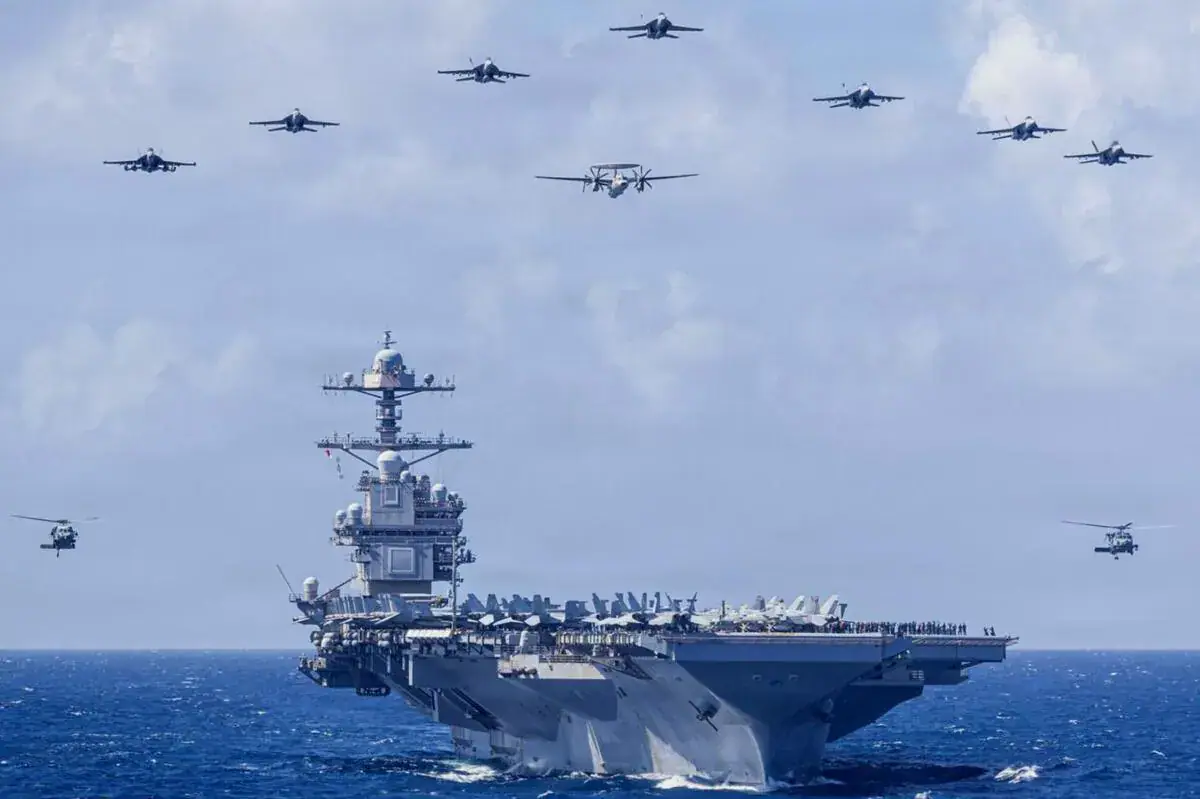
The United States has significantly bolstered its military presence in the Middle East, with three aircraft carriers, including the USS Theodore Roosevelt, USS George H. Bush, and USS George Washington, now deployed in the region. This show of force, accompanied by hundreds of warplanes and thousands of troops, has raised concerns about a potential attack on Iran. The deployment is the largest since the 2003 invasion of Iraq.
The US military buildup includes two amphibious assault ships, the USS Boxer and USS Makin Island, which carry units of expeditionary forces with thousands of combatants. These ships also have the capability to launch dozens of helicopters and F-35 vertical takeoff aircraft. The deployment has been complemented by a significant increase in military aircraft stationed in Jordan and Israel, including tanker planes to refuel the hundreds of fighter jets already in the region.
Despite US President Donald Trump stating after the midterm elections that he does not intend to order new attacks on Iran, the ongoing deployment of military assets suggests otherwise. Trump's previous assurances have been met with skepticism, particularly given his administration's history of using military threats to mask actual intentions. Israeli Prime Minister Benjamin Netanyahu, who is facing potential indictment on corruption charges, has reportedly been pressing Trump to take action against Iran.
The situation has been further complicated by repeated attacks on Iranian missile systems and radar installations by the US, to which Iran has responded with attacks on US radar systems and oil tankers attempting to pass through the Strait of Hormuz without authorization. The Iranian Revolutionary Guard Corps (IRGC) has warned that it will not wait for a US attack before launching a retaliatory strike.
Iranian Supreme Leader Ayatollah Mojtaba Khamenei has reportedly ordered the expansion of the country's retaliatory capabilities, including the use of hypersonic ballistic missiles that can reach targets up to 4,000 kilometers away. This development has raised concerns about the potential for a wider conflict, with US bases in Europe now within range of Iranian missiles.
The situation is set to be discussed at a historic meeting between Trump, Russian President Vladimir Putin, and Chinese President Xi Jinping in the Chinese city of Shenzhen. The conflict in the Persian Gulf has had a significant impact on the global economy, and finding a resolution will be a key topic of discussion among the three leaders.
While the US military deployment has been framed as a show of force, some analysts believe that the decision to go to war may already have been made, with the current preparations simply a matter of timing. The US Congress, which will soon be controlled by Democrats, has vowed to take action to prevent a war with Iran, adding another layer of complexity to the situation.
Key points
- The US has deployed three aircraft carriers and hundreds of warplanes to the Middle East, sparking concerns of an imminent attack on Iran.
- Iranian Supreme Leader Ayatollah Mojtaba Khamenei has ordered the expansion of the country's retaliatory capabilities, including the use of hypersonic ballistic missiles.
- The conflict in the Persian Gulf will be discussed at a meeting between Trump, Putin, and Xi Jinping in Shenzhen.
Reporting sources
- Médio Oriente: O que vai Trump fazer com tanto poder... · novojornal.co.ao