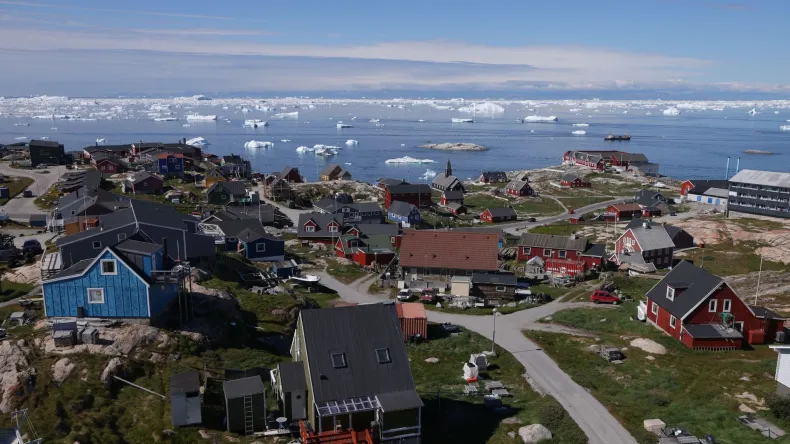
The United States, Denmark, and Greenland have concluded a tripartite security agreement, solidifying military and security cooperation in the island. This development comes after months of diplomatic negotiations and political tensions. The agreement was reached on the sidelines of the United Nations General Assembly in New York. It confirms Greenland's status under Danish sovereignty while acknowledging the right of its residents to self-determination.
The agreement allows for the expansion of US military presence in Greenland, including the establishment of two new bases, in addition to the existing Bitoviq space base in northwest Greenland. It also ensures continued US access to the island and airspace, with the possibility of expanding military facilities and increasing troop numbers. The Bitoviq base maintains its pivotal role in the US defense system, particularly in early missile warning and space monitoring.
The strategic location of Greenland, situated between North America and the Arctic, lends significant importance to monitoring air and space movements and addressing regional security challenges. The agreement restricts the establishment of bases or deployment of troops from non-NATO countries, effectively precluding Russian or Chinese military presence in Greenland. This development underscores the island's growing significance in the security calculations of the US and its allies in the Arctic region.
On September 18, US President Joe Biden announced that the US had reached an agreement with Denmark and Greenland, enabling Washington to enhance its military presence in the island. The agreement allows the US to take measures it deems necessary to ensure the security of Greenland and the US. According to Reuters, the agreement does not imply a transfer of Greenland's sovereignty to the US, as the island remains an autonomous territory within the Kingdom of Denmark.
The agreement focuses on security and military aspects, building on existing US rights under a 1951 defense agreement. The arrangement has been hailed as a means to bolster security in the North Atlantic and Arctic regions. Greenland's Prime Minister, Jens-Frederik Nielsen, stated that the agreement takes into account Greenland's interests and its position in international cooperation.
The new agreement marks a shift towards security and military cooperation, rather than pursuing a change in Greenland's political status or sovereignty. This development follows months of tension between Washington and Copenhagen, sparked by the US interest in Greenland's strategic importance. The agreement has been seen as a way to strengthen NATO's presence in the Arctic, while acknowledging Greenland's autonomy and Danish sovereignty.
The agreement is set to make Greenland a key location in the security calculations of the US and its allies in the Arctic. While the island's future political status remains a subject of discussion, the new security arrangement has provided a framework for enhanced cooperation and stability in the region. The implementation of the agreement is expected to have significant implications for regional security dynamics.
Key points
- The US, Denmark, and Greenland have reached a new tripartite security agreement, strengthening military cooperation and US presence in the island.
- The agreement confirms Greenland's status under Danish sovereignty while acknowledging the right of its residents to self-determination.
- The agreement restricts the establishment of bases or deployment of troops from non-NATO countries in Greenland.