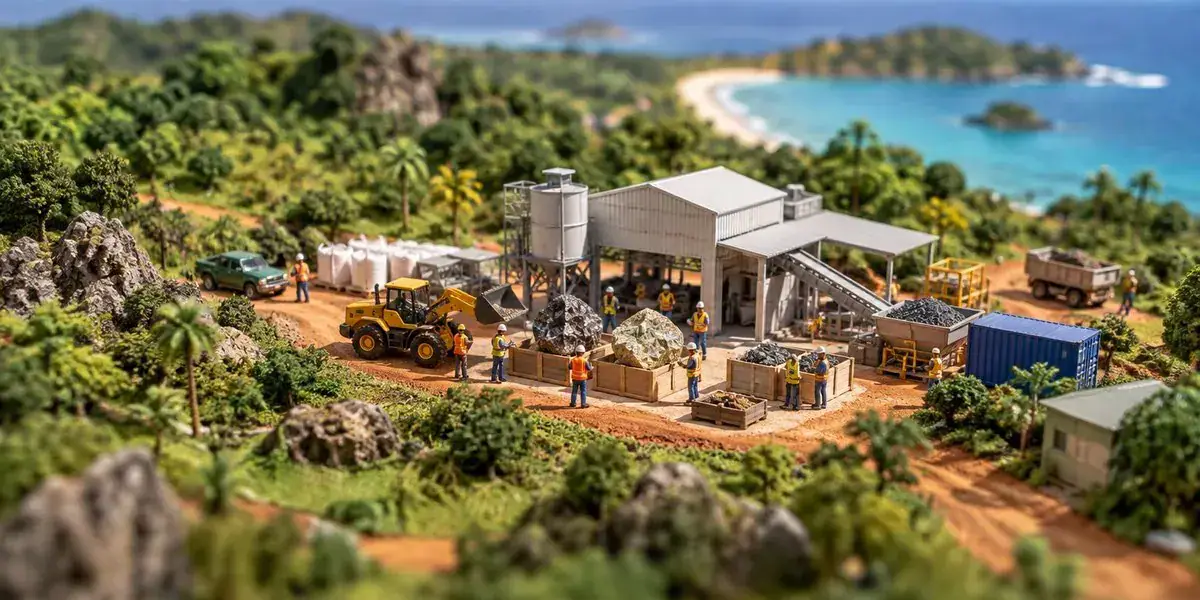
The Kenyan government has selected the Frontier Minerals Consortium, a US-backed group, to develop the Mrima Hill deposit in Kwale County. The site holds significant reserves of niobium, rare-earth elements, and associated minerals. This development positions East Africa as a new front in the global race for critical-minerals supply. The consortium, comprising ReElement Technologies, Frontier Minerals LLC, Bunker Hill Mining Corp, and American Resources Corporation, will need to complete statutory approvals before commencing work.
The Frontier Minerals Consortium brings together a diverse range of expertise in mining, resource development, and critical-materials processing. ReElement Technologies specializes in rare-earth refining, which will be crucial for the project. The consortium has pledged to build mineral processing and refining capacity inside Kenya, aligning with the Kenyan government's aim to retain value from mineral production rather than exporting raw ore. This commitment includes local supplier development, employment, and technical training.
The Kenyan government's tender criteria for the project weighted bidders on technical and financial capacity, local processing commitments, employment, local content, environmental restoration, and cultural-heritage protection. The Mrima Hill project is significant, as its minerals feed into various high-demand industries, including electronics, aerospace, defense, and electric-vehicle supply chains. Niobium serves aerospace applications, while rare earths support permanent magnets and advanced manufacturing.
The award of the Mrima Hill project to a US-backed consortium opens a new commercial entry point for Washington in East Africa. This development is particularly noteworthy, given that China currently dominates global refining of both niobium and rare earths. The Kenyan government's approach to evaluating each project on its own merits, rather than consolidating its minerals sector around a single foreign partner, reflects patterns seen elsewhere on the continent.
The same tender round that awarded the Mrima Hill project to the Frontier Minerals Consortium also saw Chinese-linked winners in other projects. Fangda Special Steel Technology and Sinohydro Corporation will jointly develop the Kang'ura chromite project in Samburu County and the Kamacabi copper project in Tharaka Nithi County. This indicates that Kenya is not relying on a single foreign partner for its minerals sector.
The Mrima Hill project now enters a demanding regulatory phase, with the consortium required to engage host communities, obtain the requisite consents, and apply for a prospecting licence. Environmental approvals, an exploration programme, and a feasibility study will follow before any mining can commence. The project's investable timetable will be shaped by these outstanding steps, including community engagement and environmental consents.
The award of the Mrima Hill project reflects the Kenyan government's focus on value addition and local development. By prioritizing technical and financial capacity, local processing commitments, and environmental restoration, the government aims to ensure that the project benefits the local community and the economy. The project's success will depend on the consortium's ability to navigate the regulatory phase and meet the government's expectations.
Key points
- The US-backed Frontier Minerals Consortium will develop the Mrima Hill deposit in Kwale County, Kenya.
- The project will help reduce China's dominance in global refining of niobium and rare earths.
- The Kenyan government's approach to evaluating each project on its own merits reflects patterns seen elsewhere on the continent, including Botswana's evolving mining partnerships.
Reporting sources
- US consortium wins Kenya rare-earth project at Mrima Hill · FurtherAfrica