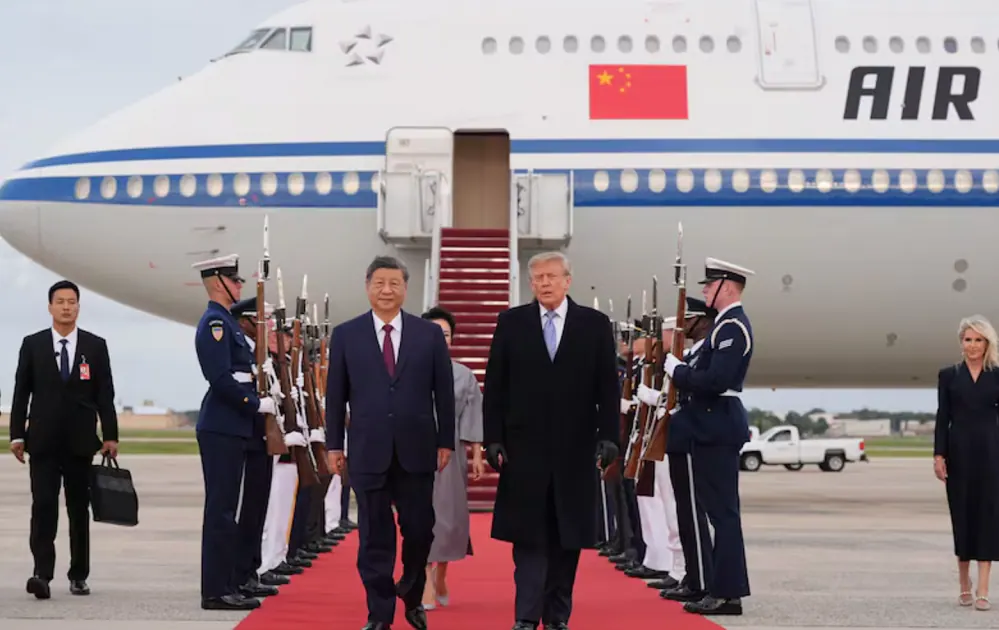
Chinese President Xi Jinping arrived at Andrew's Air Force Base on September 23, 2026, for a state visit to the United States, where he was received by US President Donald Trump and his wife, Melanie. The elaborate welcome ceremony included a 21-person honor cordon, the US Air Force band, and a flyover by B-1 bombers. This grand reception was seen as unusual in Washington protocols, sparking mixed reactions from Americans.
The reception afforded to President Xi was criticized by many Americans, who felt that Trump was treating him as a valued guest rather than a rival. Both Republicans and Democrats expressed angst over Trump's warm welcome, citing China's human rights record and its competitive relationship with the US. In contrast, when Trump visited Beijing in May, he was received at the airport by the Vice President of China.
The US-China relationship is complex, with both countries competing in various areas, including trade, military, and technology. The two nations are the largest economies in the world, and their decisions and actions have a significant impact on the global economy and energy markets. Despite their competition, the US and China also cooperate on various issues, including trade and security.
One of the key areas of conflict between the US and China is Taiwan, which China views as an integral part of its territory. The US has been providing military and diplomatic support to Taiwan, which China sees as a negation of its national interest. President Xi Jinping has stated that reunifying Taiwan with China is a key part of his mission.
President Xi Jinping is known for his calculated and reserved approach, which contrasts with Trump's more emotional and boisterous style. Xi's leadership has been marked by a significant shift in China's economic and military policies, and he has been working to assert China's influence globally. His visit to the US was seen as an opportunity for both countries to discuss their differences and find areas of cooperation.
The US-China relationship has been impacted by various factors, including the tariff wars that have been ongoing since Trump's presidency. The trade tensions have had significant economic implications for both countries, with the US experiencing a rise in household item prices and China facing a decline in exports and revenue. China has been working to diversify its trade relationships, particularly with countries in the global south.
The dynamics of the US-China relationship are further complicated by China's authoritarian system and its alliances with other countries with similar systems. The US has expressed concerns about China's human rights record and its support for countries like Russia and Iran. As the two nations continue to navigate their complex relationship, it remains to be seen how their interactions will shape the global landscape.
Key points
- The US-China relationship is marked by both cooperation and competition, with the two nations vying for influence in areas such as trade, technology, and security.