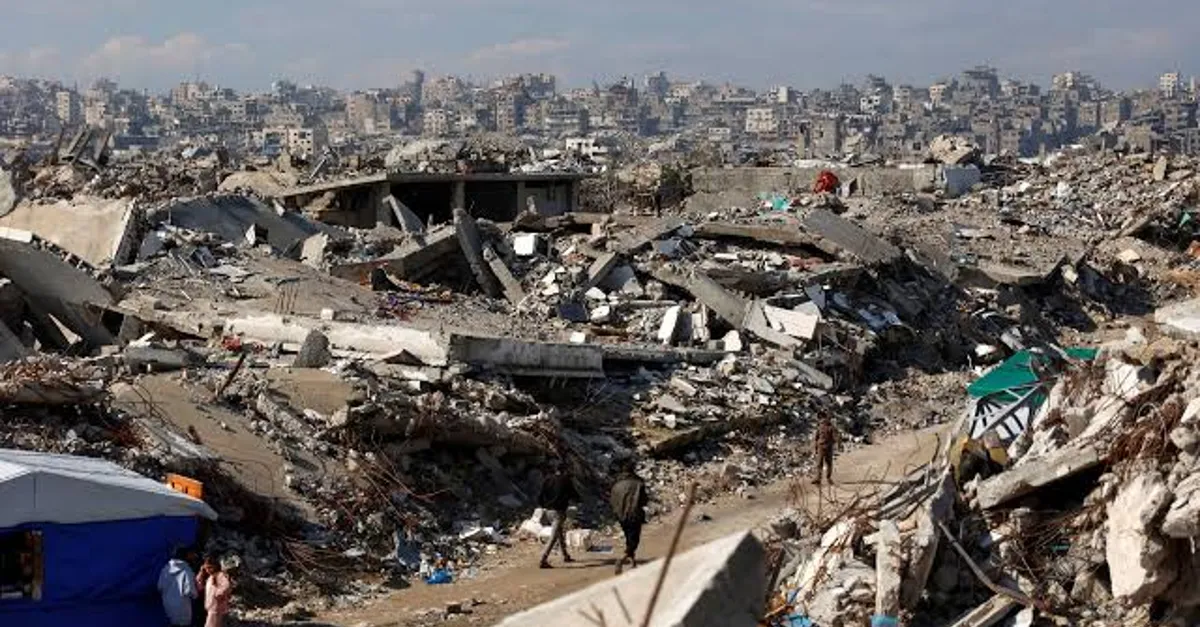
The US-backed Peace Council, led by US President Donald Trump's administration, is set to unveil a $2.45 billion six-month plan to help Gaza recover and rebuild. According to Axios, the plan is the result of a year-long effort by dozens of people from the Peace Council, which comprises 28 member countries, and the Palestinian technocratic government. The plan includes funding for temporary housing, debris removal, hospital repairs, economic recovery, and the deployment of a multinational security force.
The plan, which has been obtained by Axios, outlines a comprehensive approach to rebuilding Gaza, including infrastructure development, economic growth, and security. A senior Peace Council official described the plan as a roadmap for establishing a government from scratch, an economy from chaos, and a region from catastrophe. The plan has been discussed with various stakeholders, including the Israeli government, which has given its preliminary approval to certain aspects of the plan.
However, the Israeli government has refused to begin implementing the plan due to domestic political considerations ahead of the October 27 elections. Hamas, the de facto ruler of Gaza, has given its preliminary approval to the plan, including the disarmament of its militant wings. However, the disarmament process has yet to be tested, partly due to Israel's reluctance to implement a 14-day ceasefire before the process begins.
The Peace Council hopes that the reconstruction process will begin in earnest after the Israeli elections and the formation of a new Israeli government. According to the plan, the damage to Gaza's infrastructure is estimated at $35.2 billion, and full recovery and rebuilding are expected to cost around $71.4 billion over the next decade. The plan allocates funding across six areas, including infrastructure development, human development, economic acceleration, digital transformation, legal affairs, and peace and security.
Infrastructure development is allocated the largest share of funding, with around $1 billion earmarked for projects, including $400 million for temporary shelters, $275 million for debris removal and unexploded ordnance, $50 million for hospital rehabilitation, and $30 million for road repairs. The plan also includes funding for border crossing repairs, electricity and water infrastructure rehabilitation, and the deployment of 25,000 portable solar panels.
The plan also allocates significant funding for security, with around $885 million earmarked for projects, including the establishment of a permanent fortified site in Rafah to support a 5,000-strong international stabilization force. An additional $140 million is allocated for the recruitment, training, and deployment of a multinational security force. The plan also includes funding for the Palestinian police force and the purchase of armored vehicles for displaced Palestinians.
The plan's success is contingent on securing funding from donor countries, with representatives from 35 countries, including the European Union, expected to attend a briefing by the Peace Council. Officials are confident that once the political obstacles are removed, donor countries will provide the necessary funding to support the various projects outlined in the plan.
Key points
- The plan allocates $2.45 billion for Gaza's recovery and rebuilding efforts.
- The plan includes funding for infrastructure development, security, and economic recovery.
- The plan's success depends on securing funding from donor countries.