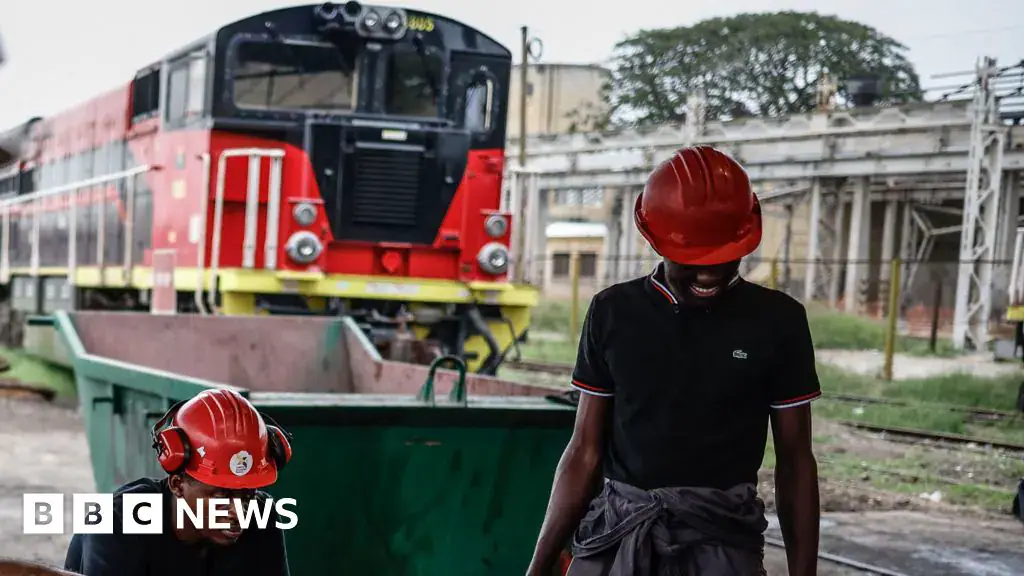
The Lobito Corridor, a US-backed effort, has become a vital transportation route for minerals from the Democratic Republic of Congo to Western markets via Angola. The railway, which has been in operation since 1902, was rebuilt and fully reopened in 2015 after years of disruption during Angola's civil war. For residents like 20-year-old Manuela Julia, the railway has made traveling cheaper and more convenient.
The Lobito Corridor links DR Congo's mineral-rich south to Angola's Atlantic coast through the Benguela Railway and the Port of Lobito. Its importance has grown as demand for copper and cobalt rises, driven partly by the global transition to cleaner energy. DR Congo is the world's largest producer of cobalt and one of its biggest copper producers, along with neighbouring Zambia.
The US sees the corridor as a means to diversify mineral supplies and reduce reliance on China, which dominates much of the world's processing capacity. A US-DR Congo strategic partnership identifies the route from the Congolese town of Sakania to Lobito as a priority for mineral exports. The project has attracted over $750m in funding, including from the US International Development Finance Corporation and the Development Bank of Southern Africa.
The railway offers a shorter route to international markets for mining companies. Lobito Atlantic Railway (LAR), which has a 30-year concession to operate freight services along the corridor, expects to transport about 200,000 tonnes of copper through the corridor in 2026. Freight volumes have more than doubled since LAR took over in January 2024.
However, a more efficient route to market does not automatically translate into economic transformation. Some experts argue that the test is not simply whether Zambia gains another route to the sea, but whether that route helps build a stronger economy. The challenge is turning the ambition of economic transformation into reality.
For residents along the route, the benefits have been immediate. State-owned railway operator Caminho de Ferro de Benguela (CFB) carried a record 1.6 million passengers in 2025. LAR says it directly employs nearly 1,000 people, 98% of them Angolan. The railway passes through some of Angola's most productive agricultural regions, and better transport links could help farmers reach larger markets and reduce losses.
The bigger opportunity is developing local businesses in engineering, maintenance, warehousing, and agricultural processing. However, can minerals and their movement along the railways line help deliver peace to eastern DR Congo, where the battle for control of mineral resources has fuelled decades of conflict? The Congolese government says neighbouring Rwanda is backing the M23 rebel group, which has seized control of many mineral-rich areas.
Key points
- The Lobito Corridor has attracted over $750m in funding to upgrade railway tracks, signalling systems, and trains.
- The railway offers a shorter route to international markets for mining companies, with Lobito Atlantic Railway expecting to transport about 200,000 tonnes of copper through the corridor in 2026.
- The project aims to promote transparent mineral supply chains and regional economic cooperation, which could help bring peace to conflict-torn eastern DR Congo.