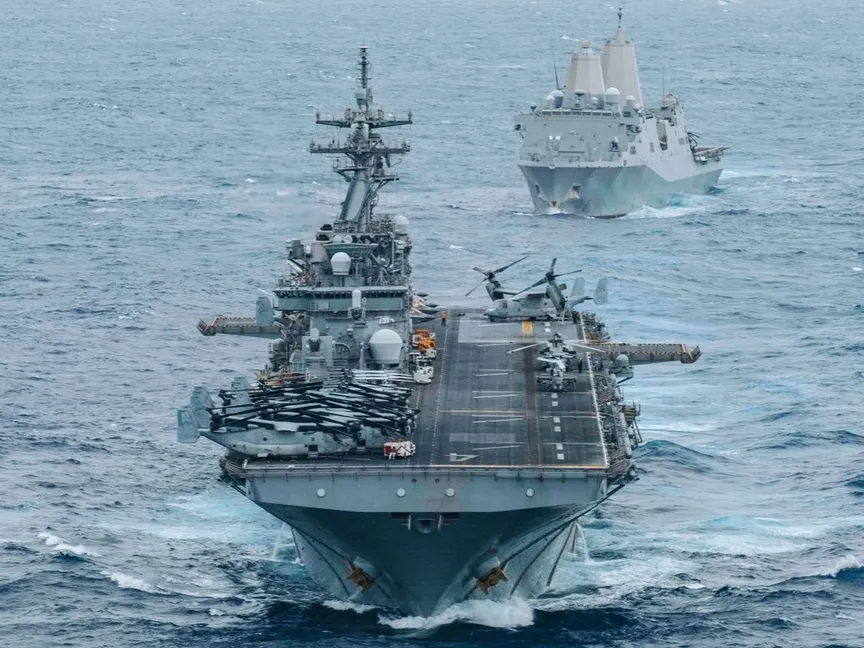
The United States and Iran have signaled a prolonged conflict as Washington prepares for talks at the UN General Assembly. US Vice President J.D. Vance announced that the US will pursue further discussions on the war during the assembly. Vance stated that the US is actively working to protect its naval forces, which are currently imposing a blockade on Iran. He emphasized that oil continues to flow through the Strait of Hormuz despite Iranian attacks on commercial ships and tankers.
The Islamic Revolutionary Guard Corps (IRGC) warned on Monday that Iran will deploy new weapons and target locations not previously attacked if the US launches a new strike. IRGC spokesperson Hossein Muhebi stated that the country is prepared for a long-term conflict. Muhebi's remarks coincided with renewed tensions between the US and Iran. The IRGC's warning follows statements from US President Donald Trump, who said he faces three options regarding Iran and is currently in a "decision-making phase".
US President Donald Trump stated that his options are to "completely eliminate Iran", leave it to "rot economically", or reach an agreement. Trump added that "very big things" will happen in the not-too-distant future. He also expressed openness to meeting Iranian President Masoud Pezeshkian, who is expected to arrive in New York on Tuesday for the UN General Assembly. The potential meeting between the two leaders has raised hopes for a diplomatic resolution to the conflict.
US Treasury Secretary Scott Bessent said that Washington has discussed the conflict with China, describing Beijing as "very engaged" in the process. Bessent also announced that all Iranian airlines will cease operations worldwide on September 23. The move is seen as a significant escalation of economic pressure on Iran. The US and its allies have been working to isolate Iran and limit its ability to access international markets.
Oil prices fell on Monday, approaching $100 per barrel to hit 11-day lows, driven by investor hopes that the diplomatic gatherings in New York could yield progress on the war. Early on Monday, Brent crude and US West Texas Intermediate (WTI) futures touched their lowest levels since September 10. The decline in oil prices has been attributed to increased optimism about a potential diplomatic solution to the conflict.
The conflict between the US and Iran has had significant regional implications, with Egypt condemning attacks and backing Gulf states and Jordan. The Egyptian government has expressed concern about the escalation of violence and its potential impact on regional stability. The international community has been working to prevent a wider conflict in the region.
The situation remains tense as the US and Iran prepare for talks at the UN General Assembly. The outcome of the talks is uncertain, and the conflict could have significant implications for global security and stability. Key issues, including the potential for a new US strike and Iran's threat to deploy new weapons, remain unresolved.
Key points
- The US and Iran have signaled a prolonged conflict as Washington prepares for talks at the UN General Assembly.
- The Islamic Revolutionary Guard Corps (IRGC) has warned that Iran will deploy new weapons and target locations not previously attacked if the US launches a new strike.
- US President Donald Trump has stated that he faces three options regarding Iran, including "completely eliminating" the country, leaving it to "rot economically", or reaching an agreement.