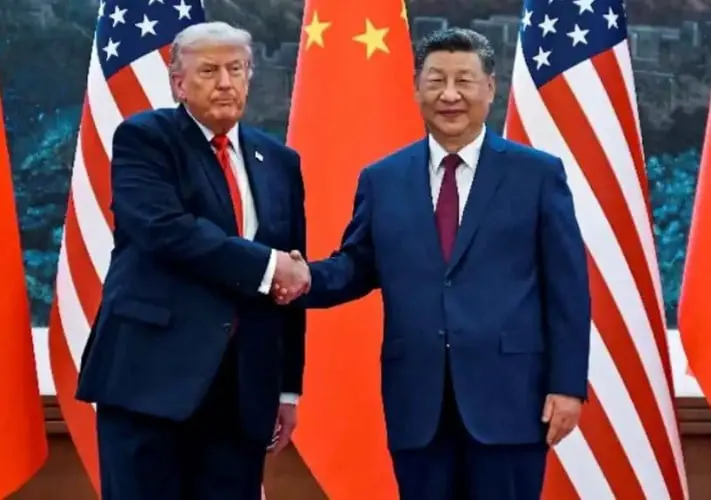
US Treasury Secretary Scott Mnuchin proposed establishing a new mechanism for notifying incidents related to artificial intelligence (AI) with national security implications during talks with Chinese Vice Premier He Lifeng in New York. The move aims to enhance transparency between the world's two largest AI powers. The discussions focused on AI, trade, and biotech, as the two sides seek to pave the way for potential agreements during the upcoming summit between US President Donald Trump and Chinese President Xi Jinping.
Mnuchin stated that Washington proposed launching a new US-China dialogue on AI, focusing on national security concerns and establishing a system for notifying incidents associated with AI that pose a threat to national security. He emphasized the significance of transitioning from uncertainty to greater transparency between the two AI leaders, especially given the cross-border nature of advanced technology activities. This development is crucial as it may impact the future of AI development and its applications.
The Chinese side has not yet finalized its stance on the US proposal, with a report by the official Xinhua news agency only mentioning that both sides discussed AI, along with "candid, in-depth, and constructive" exchanges on major economic and trade issues. The lack of clear information from China has left the outcome of the proposal uncertain. Further discussions are expected to take place, potentially leading to a clearer understanding of the proposal.
According to George Chen, a partner and head of digital technology practice at the Asia Group consultancy in Hong Kong, the continued dialogue represents an important development. He expects future discussions to address more sensitive topics, including the use of AI in military fields, safety principles, protection of critical infrastructure, and prevention of cyberattacks. These topics are crucial in establishing a framework for AI development and deployment.
In parallel with the AI discussions, the two sides also explored activating a process agreed upon in May to identify non-strategic goods that could have tariffs reduced. US Trade Representative Jameson Greer stated that Washington aims to target a relatively limited list of sensitive US and Chinese goods, allowing for more balanced trade between the two countries. This development could lead to increased trade and economic cooperation between the US and China.
The products that could be eligible for tariff reductions include Chinese consumer goods and low-tech products, while potential US exports may comprise energy, agricultural products, and medical devices. However, the US has not announced progress on accessing biotech materials for US companies or new developments on Chinese commitments to increase purchases of US agricultural products or buy over 200 Boeing aircraft. These issues remain key areas of discussion in the trade talks.
The talks take place as the US-China trade truce approaches its expiration date on November 10, with Washington and Beijing preparing for the Trump-Xi summit. Despite ongoing differences on trade, investment, technology, and national security, both sides seem committed to finding common ground. The outcome of these discussions may have significant implications for the future of US-China relations and global trade.
Key points
- The US proposes a new mechanism for notifying AI incidents with national security implications to enhance transparency between the two global AI powers.
- The two sides discussed potential tariff reductions on non-strategic goods, aiming to increase balanced trade between the US and China.
- The talks occur as the US-China trade truce nears its expiration date, with both sides preparing for the upcoming Trump-Xi summit.