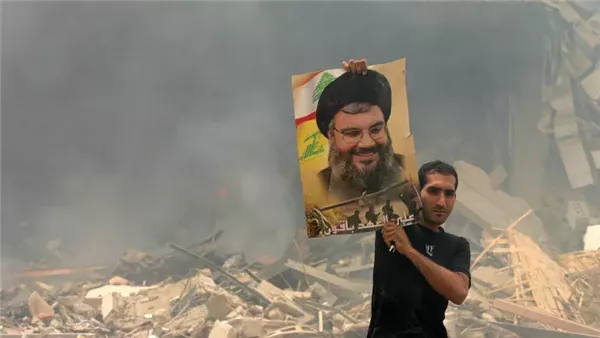
On September 27, 2024, a significant event took place in the history of the Arab and Islamic world. Israel announced the assassination of Hassan Nasrallah, the third Secretary-General of Hezbollah, in an unprecedented airstrike targeting the underground command center in the heart of Beirut's southern suburbs. This marked the end of a controversial and influential figure's life, who had been a key player for over three decades in what is known as the "Axis of Resistance."
Hassan Nasrallah was born in 1960 in Beirut's impoverished Karantina neighborhood, to a father who worked as a vegetable and fruit vendor. His family relocated to the southern Lebanese town of Bazourieh during the Lebanese Civil War in 1975. At a young age, Nasrallah joined the Amal Movement and later traveled to Najaf, Iraq, to study at the historic Hawza. It was there that he met Abbas al-Mousawi, who became his mentor and shaped his religious and political views.
Nasrallah's rise to prominence began with the Israeli invasion of Lebanon in 1982. He broke away from Amal, along with other young leaders, and founded Hezbollah with direct support and armament from the Iranian Revolutionary Guard. The party combined religious ideology, social welfare, and strict military organization. After Abbas al-Mousawi's assassination in 1992, Nasrallah was elected Secretary-General at just 32 years old, marking a new era for the organization.
Under Nasrallah's leadership, Hezbollah was able to liberate southern Lebanon in 2000, forcing Israel to withdraw without conditions. This victory earned him immense popularity beyond sectarian and geographical boundaries. He led several wars against Israel, including the 2006 Lebanon War, which, despite significant material losses, solidified his reputation as a resilient leader.
Nasrallah chose not to pursue executive positions in the Lebanese government, opting instead to maintain his role as Hezbollah's Secretary-General and a key figure in the resistance. This allowed him to wield significant influence without being bound by the constraints of government office. His leadership extended beyond Lebanon, as he became a pivotal figure in the Axis of Resistance, coordinating efforts across the region.
In the months leading up to his assassination, Nasrallah played a crucial role in supporting various factions within the Axis of Resistance. Following the October 7, 2023, Hamas attacks on Israel and the subsequent war on Gaza, Nasrallah opened a new front in southern Lebanon, further entrenching his position as a key player in regional politics.
After his assassination, Nasrallah's body was secretly transferred and buried in a hidden location. Five months later, on February 23, 2025, his body was exhumed and transferred to a specially prepared burial site at Beirut's airport, where he was laid to rest in a ceremony attended by thousands.
Key points
- Hassan Nasrallah's assassination marked the end of an era for Hezbollah and the Axis of Resistance.
- Nasrallah played a pivotal role in shaping regional politics and resistance movements.
- The circumstances surrounding Nasrallah's burial reflect the secrecy and security concerns of Hezbollah and its allies.