Deep within the ancient Egyptian ruins, a mysterious figure has long been shrouded in secrecy. Prince Seti III, son of King Seti II, was once poised to inherit the Egyptian throne, with inscriptions and artifacts highlighting his prominent position as crown prince. Despite his seemingly destined path to power, Prince Seti III vanished from the historical scene before he could claim the throne. According to Mahmoud Farouk, head of the Luxor Temple workers, the prince's story is one of the many enigmas tied to a tumultuous period in ancient Egyptian history.
Inscriptions and relics have provided a glimpse into the life of Prince Seti III, showcasing his status as the legitimate son of King Seti II and his significant position as heir to the throne. This distinction placed him near the center of power, with the title of crown prince reflecting a high-ranking position within the royal family. Such prominence suggested that he could have potentially succeeded his father, but events unfolded differently. The prince's connection to the royal lineage and his potential to ascend to the throne have sparked curiosity among historians.
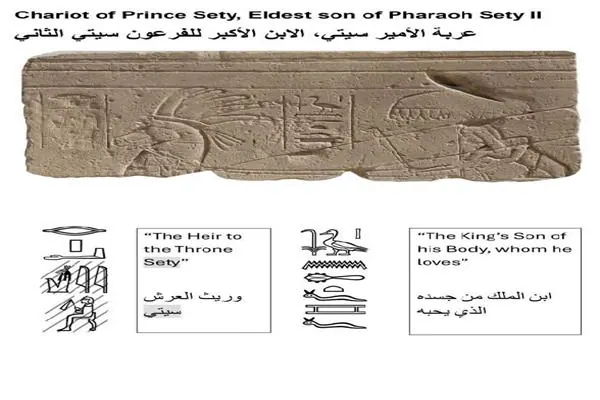
A rare and remarkable scene discovered within the temples of Karnak offers a unique insight into Prince Seti III's status. The scene depicts the prince on a lavish chariot, adorned with a solar umbrella, accompanied by soldiers. This image, as noted by Mahmoud Farouk, portrays a prince with considerable royal and military stature, offering a glimpse into the role he might have played within the royal and military institutions of that era. Such scenes are significant, as they not only provide a visual representation of a royal figure but also help to understand the position and influence they held within ancient Egyptian society.
Despite his prominent position as heir apparent, Prince Seti III never ascended to the throne, as he predeceased his father, King Seti II. Following the prince's death, Egypt entered a period marked by power struggles, according to Farouk. This tumultuous transition led to the rise of King Amenmesse, marking the beginning of a complex period in the transfer of power during the late 19th dynasty. The circumstances surrounding Prince Seti III's death and the subsequent power vacuum have contributed to the mystique surrounding his life and legacy.
A pressing question remains regarding the fate of Prince Seti III: where did he disappear to after his death? If he was indeed a royal prince and heir apparent, featured in inscriptions with such prominence, the mystery surrounding his final resting place persists. The absence of a definitive answer regarding his burial site adds another layer to the enigma of this historical figure, particularly since royal and princely tombs serve as crucial sources for understanding the lives of their occupants and the associated funerary rituals and religious beliefs.
Although Prince Seti III never claimed the throne, archaeological inscriptions have preserved aspects of his story, allowing researchers to reexamine this figure connected to the 19th dynasty. The scene of the prince on his chariot, set amidst a military and royal backdrop, presents a distinct image of a prince whose political narrative remained incomplete. Meanwhile, the details surrounding his demise and burial site remain topics that require further archaeological investigation and study.
The story of Prince Seti III serves as a reminder that ancient Egyptian history was not solely defined by the rulers who ascended to the throne but also by the royal figures who lived on the periphery of power. Their stories, etched on temple walls, offer a glimpse into lives that, although overshadowed by more prominent historical events, played significant roles in shaping the kingdom. Prince Seti III, an heir without a crown, exemplifies the complexities and mysteries that continue to unfold within the study of ancient Egyptian history.
Key points
- Prince Seti III's story is a testament to the intricate and often mysterious nature of ancient Egyptian royal lineage and power transitions.
- The prince's prominent position as heir apparent is well-documented through various inscriptions and artifacts, highlighting his significance within the royal family.
- Despite his seemingly destined path to power, Prince Seti III's premature death prevented him from ascending to the throne, leading to a period of power struggles in Egypt.