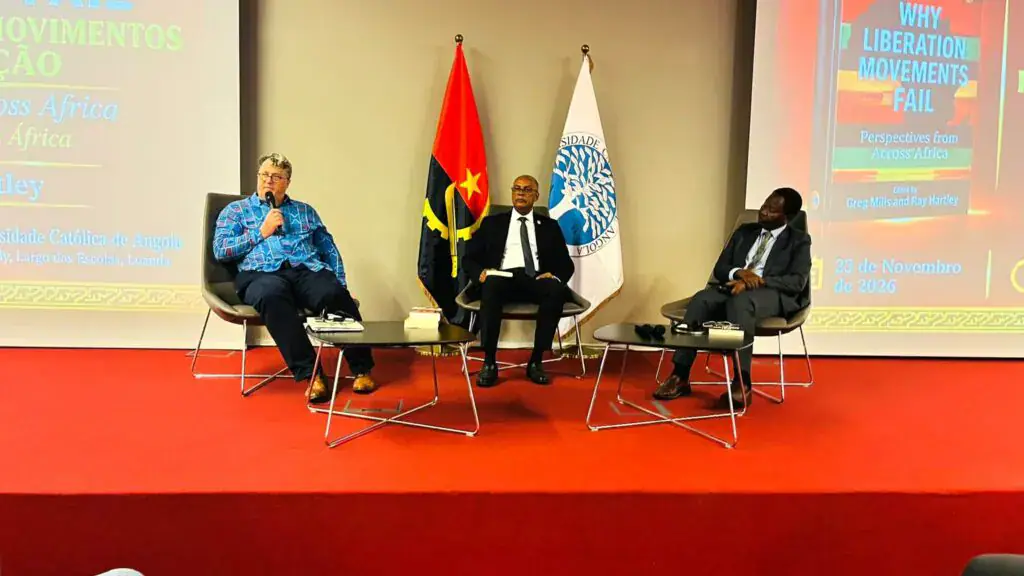
The launch of the book "Why Liberation Movements Fail – Perspectives from Across Africa" took place on November 23 at the Catholic University of Angola (UCAN) in Luanda. The event was attended by academics, politicians, diplomats, traditional authorities, and civil society representatives interested in African politics and governance. The book was coordinated by researchers Greg Mills and Ray Hartley.
The ceremony was a critical reflection on the historical trajectory of national liberation movements in Africa, analyzing their transition to power and current challenges. Countries such as Angola, South Africa, Mozambique, and Zimbabwe were discussed, with a focus on their democratic and socioeconomic challenges. UNITA President Adalberto Costa Júnior highlighted the importance of the debate, stating that the book is not just a critique of rulers but also a call to collective reflection on Africa's development paths.
Greg Mills argued that some of Africa's current governance challenges are linked to the maintenance of exclusionary and extractive power structures inherited from the colonial period. He emphasized the need to understand the mechanisms of power distribution and control, as well as the factors contributing to the exclusion and marginalization of certain sectors of society. Mills also stressed the importance of learning from other countries' experiences, as there are no one-size-fits-all governance models.
The book's preface, written by Tanzanian opposition leader Tundu Lissu while in detention, was also read during the ceremony. Lissu expressed concern about the weakening of democratic institutions in Africa, questioning the functioning of electoral systems, courts, and parliaments in contexts of concentrated political power. He emphasized the importance of respecting constitutions, the rule of law, and free and transparent elections for democracy consolidation.
The launch of "Why Liberation Movements Fail – Perspectives from Across Africa" provided a platform for reflection on the trajectory of African liberation movements and their consolidation of power. The event brought together various stakeholders to discuss the challenges facing these movements and potential solutions. The book aims to contribute to the development of better public policies in Africa by analyzing the experiences of different countries.
The ceremony was part of the "Democrats for Africa" platform, which aims to promote critical reflection on African politics and governance. UNITA's attendance at the event demonstrates its commitment to engaging in discussions about the continent's development and the challenges facing its liberation movements. The book launch was an opportunity for stakeholders to share perspectives and experiences on African governance.
The discussion on African liberation movements and their transition to power is ongoing, with many stakeholders emphasizing the need for critical reflection and collective action. The launch of "Why Liberation Movements Fail – Perspectives from Across Africa" has contributed to this discussion, providing a platform for academics, politicians, and civil society representatives to engage with the challenges facing the continent.
Key points
- The book "Why Liberation Movements Fail – Perspectives from Across Africa" was launched in Luanda, discussing the trajectory of African liberation movements and their consolidation of power.