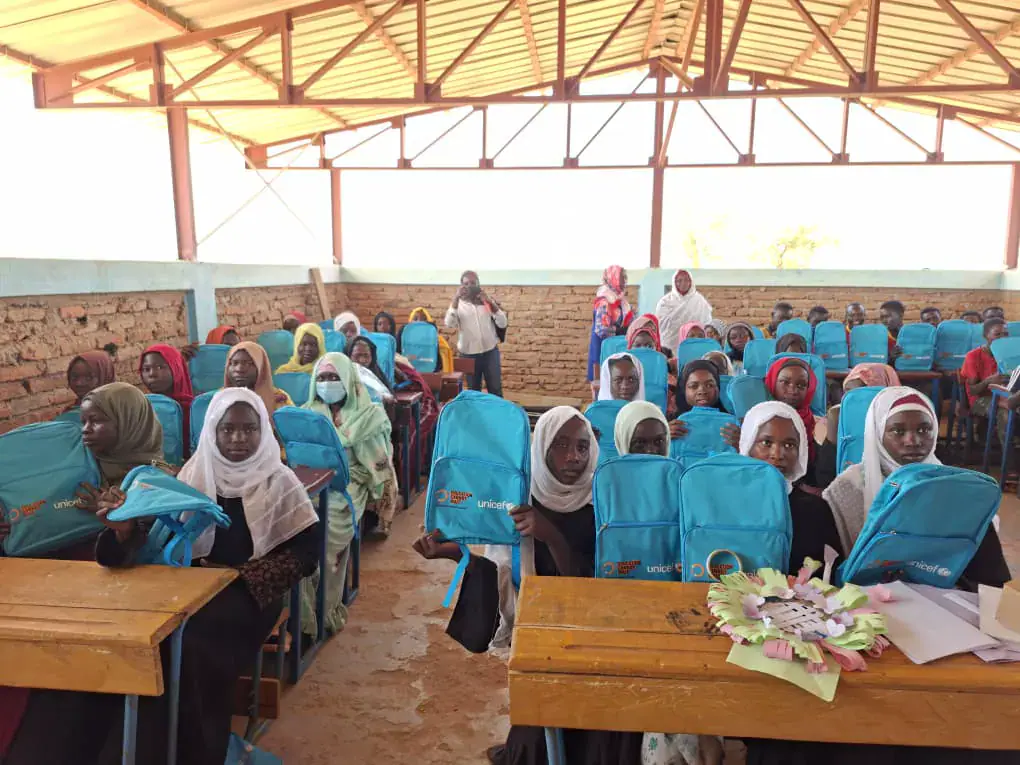
In Farchana, eastern Chad, UNICEF and its partners are working to improve access to education for Sudanese refugee children. The Al-Imtidad school, located in the Farchana site, provides a learning environment that facilitates adaptation to the Chadian education system. The school was financed by UNICEF and the UN High Commissioner for Refugees (UNHCR) and implemented by the Jesuit Refugee Service (JRS).
The Al-Imtidad school hosts Sudanese refugee teachers and students. Instruction is provided in Sudanese Arabic to facilitate understanding and accommodate the students' educational background. The goal is to enable them to continue their studies while gradually integrating into the Chadian education system. However, this transition poses significant challenges due to differences between the Sudanese and Chadian curricula.
Assafi Zakariya Assafi, director of Al-Imtidad school, notes that despite initial difficulties, efforts have been made to facilitate adaptation. He credits UNICEF and its partners for their support, which has enabled the school to integrate children into the Chadian education system. Students are gradually adapting to the Chadian curriculum and continuing their education.
For many refugee students, returning to school represents an opportunity to pursue their dreams despite the challenges of displacement. Abdelkerim Fatimé, a student at Al-Imtidad school, expresses her satisfaction with continuing her studies. She hopes to learn, succeed in school, and pursue her education to become someone in life.
Despite progress, significant needs remain unmet. Hatem Al Fadel, education supervisor in Farchana, highlights the shortage of classrooms due to the increasing number of students. He laments that infrastructure remains insufficient, affecting learning conditions. However, he appreciates the support of UNICEF and other partners, including the construction of classrooms and provision of school furniture.
The construction and equipping of schools in Farchana aim to ensure the continuity of education for children who have fled conflict in Sudan. The partnership between UNICEF, UNHCR, and JRS has made a positive impact on the lives of refugee children. As the situation continues to evolve, the need for sustained support and resources remains crucial.
The efforts of UNICEF and its partners in Farchana demonstrate the importance of collaboration in addressing the educational needs of refugee children. By providing access to quality education, these organizations help create a brighter future for young refugees and support their integration into the host community.
Key points
- UNICEF and partners improve access to education for Sudanese refugee children in eastern Chad
- Al-Imtidad school provides a learning environment that facilitates adaptation to the Chadian education system
- Despite progress, significant needs remain unmet, including a shortage of classrooms