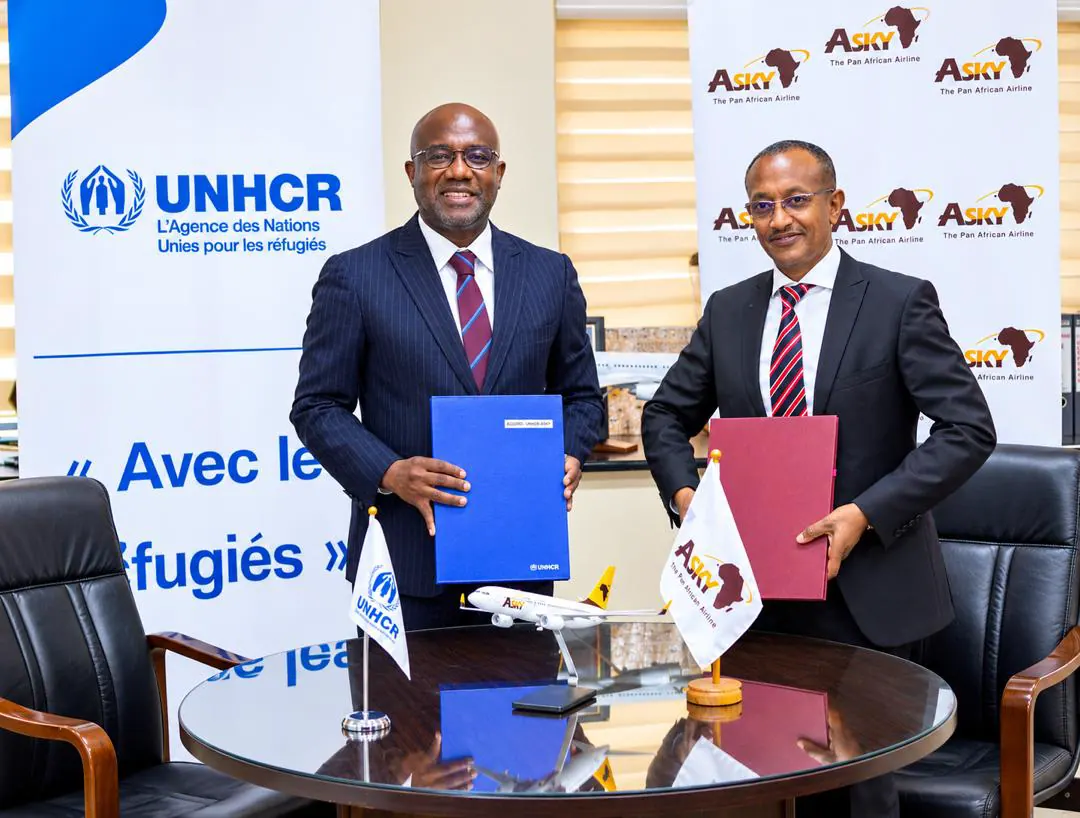
The United Nations High Commissioner for Refugees and pan-African airline ASKY have entered into a three-year partnership to provide refugees with skills development, employment, and entrepreneurship opportunities across West and Central Africa. The partnership will initially cover Senegal, Ghana, Benin, Togo, Nigeria, and Côte d'Ivoire. ASKY's aviation expertise and regional network will be combined with UNHCR's mandate to protect refugees and pursue long-term solutions to displacement.
The initiative will focus on technical and vocational training, scholarships, internships, and employment opportunities in the aviation sector. The partners will also explore opportunities for refugee-owned businesses to gain access to supply chains and markets. This partnership comes against the backdrop of a significant displacement crisis in West and Central Africa, with over four million refugees and asylum-seekers hosted in the region as of September 2026.
According to UNHCR, women and children account for about 80 percent of the displaced population, with nearly 751,000 people identified as having specific protection needs. The partnership aims to move beyond humanitarian assistance by creating pathways for refugees to acquire skills, secure decent employment, and build sustainable livelihoods. UNHCR Regional Director for West and Central Africa Abdouraouf Gnon Konde emphasized the importance of access to skills, markets, and decent work in restoring choice and dignity to refugees.
The partnership has a specific focus on empowering women and girls, who often face additional barriers to education, vocational training, and access to decent employment. The program will explore aviation-related education, mentorship, and professional development opportunities for refugee women and girls. ASKY's regional network will play a central role in connecting refugees with opportunities across different labor markets, with Lomé, Togo, considered as a potential training hub.
Under the agreement, ASKY will consider qualified refugees for places in its existing training programs, internships, and recruitment processes. The airline will also examine ways for refugee-owned businesses to participate in its supply chain. UNHCR and ASKY will work out detailed arrangements covering training, scholarships, internships, and employment, as well as humanitarian transport where appropriate.
The partnership is significant for UNHCR as it represents its first partnership with a regional airline in West and Central Africa and the first initiative of its kind in sub-Saharan Africa. The organization hopes that the partnership will serve as a practical model for African-led private-sector engagement in refugee inclusion and sustainable development. ASKY views the partnership as part of its contribution to African economic development.
The proposed collaboration is broader than aviation recruitment alone, aiming to create a link between refugee skills, private-sector demand, and regional economic opportunities. The partnership could provide refugees with opportunities in areas extending from aviation training and employment to entrepreneurship and supply-chain participation.
Key points
- The partnership will initially cover six countries in West and Central Africa.
- Women and girls will receive particular attention under the initiative.
- The partnership aims to help half of refugees in protracted displacement situations transition from long-term aid dependency towards self-reliance and lasting solutions by 2035.