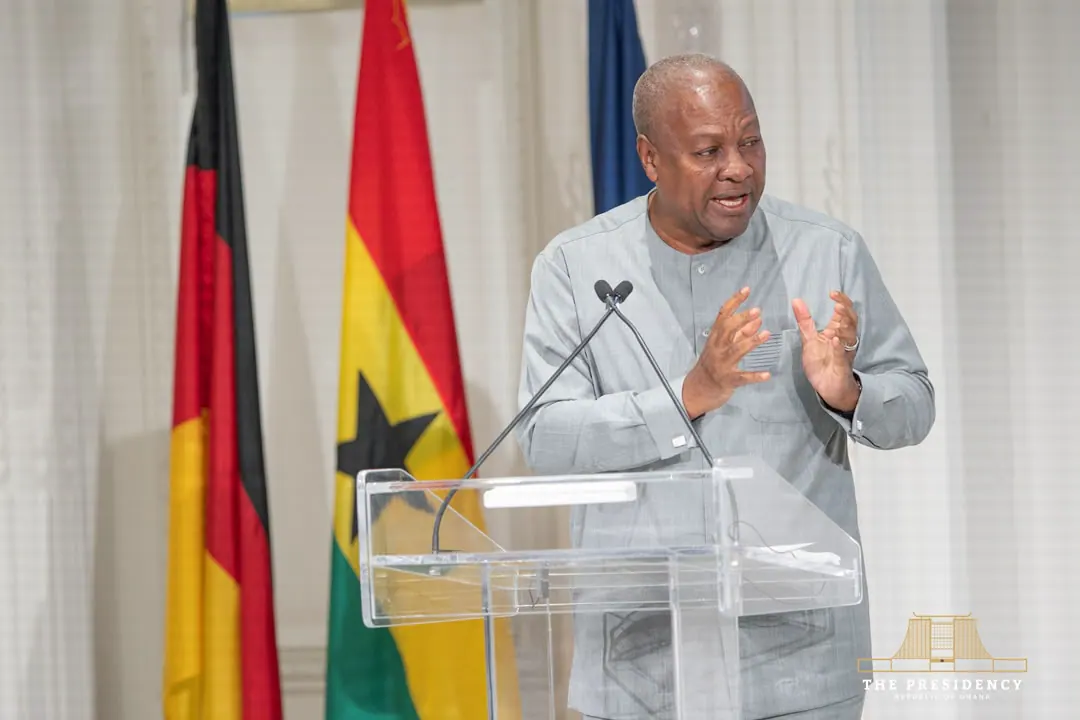
President John Dramani Mahama has outlined three key pillars to guide the next phase of Ghana's global reparatory justice campaign. Speaking at a high-level side event on the sidelines of the 81st United Nations General Assembly in New York, President Mahama said the focus must now shift from international acknowledgement to concrete action. The President emphasized that the campaign is not about assigning blame for the past, but about building international partnership.
The first priority, according to President Mahama, is to establish a permanent and institutionalized global system for the restitution of Africa's cultural heritage. He called for clear and standardized legal and diplomatic mechanisms to streamline provenance research, open up archives and remove legal barriers to the unconditional return of African cultural property and human remains. This system would facilitate the return of looted cultural property.
President Mahama cited recent commitments by European countries, demonstrating growing international support for the reparatory justice agenda. The Netherlands is cataloging 2,000 Ghanaian artefacts for return, while Germany is engaging with Ghana over cultural objects. France is also making legislative efforts on restitution. Additionally, the United Kingdom and Portugal have expressed willingness to work with Ghana and its partners on the reparatory justice agenda.
President Mahama called for the immediate and unconditional return of African human remains, sacred artefacts and other looted cultural property. He rejected arguments that restitution should be delayed due to Africa's limited capacity to preserve returned artefacts. Instead, he proposed that capacity constraints should be addressed through investment and cooperation, rather than justifying continued possession of African heritage abroad.
Africa is already developing the necessary infrastructure to receive and preserve its cultural heritage. The proposed Great African Museum, under the African Union's Agenda 2063 framework, is one example. President Mahama emphasized that the return of African artefacts is ultimately about reconnecting future generations with their history, identity and heritage. This would contribute to education, national identity and the creative economy.
President Mahama identified investment in Africa's cultural infrastructure as the third pillar of the next phase of reparatory justice. He called on multilateral development banks, international financial institutions, global foundations and the private sector to support regional archives, conservation laboratories, digitization projects and professional training. Properly preserved heritage can drive economic development and create opportunities.
The United States, despite voting against the UN resolution, has formally indicated its willingness to engage on the issue of reparatory justice. President Mahama's speech at the high-level side event garnered international attention, highlighting Ghana's commitment to the global reparatory justice campaign. The President's three-pillar approach aims to translate international acknowledgement into tangible action.
Key points
- President Mahama outlines three pillars for Ghana's global reparatory justice campaign
- Establishment of a permanent global system for restitution of Africa's cultural heritage
- Investment in Africa's cultural infrastructure to support preservation and development